Introduction to Kata Sochin | GKR Karate
GKR Karate
  • About GKR

    About GKR

    GKR Karate is a family club that is dedicated to fostering sound values and developing strong, humble, brave individuals and healthy communities.

    • What is Karate?
    • GKR Karate Club Info
    • Karate for Everyone
    • GKR Karate Belt Journey
    • Events
    • Executive Committee
    • GKR Karate History in Australia
    • Regional Managers AUS
  • Locations
  • Tournaments
  • Shop
  • Articles
  • Contact Us
  • TRY A FREE CLASS
    • Instructor Login
    • Australia
    • New Zealand
    • United Kingdom
GKR Karate
    • About GKR
      • About GKR
      • What is Karate?
      • GKR Karate Club Info
      • Karate for Everyone
      • GKR Karate Belt Journey
      • Events
      • Executive Committee
      • GKR Karate History in Australia
      • Regional Managers AUS
      Back
    • Locations
    • Tournaments
    • Shop
    • Articles
    • Contact Us
      • Australia
      • New Zealand
      • United Kingdom
    • TRY A FREE CLASS Instructor Login

Introduction to Kata Sochin

  • Home
  • About GKR
  • Black Belt 3rd Dan
  • Introduction to Kata Sochin

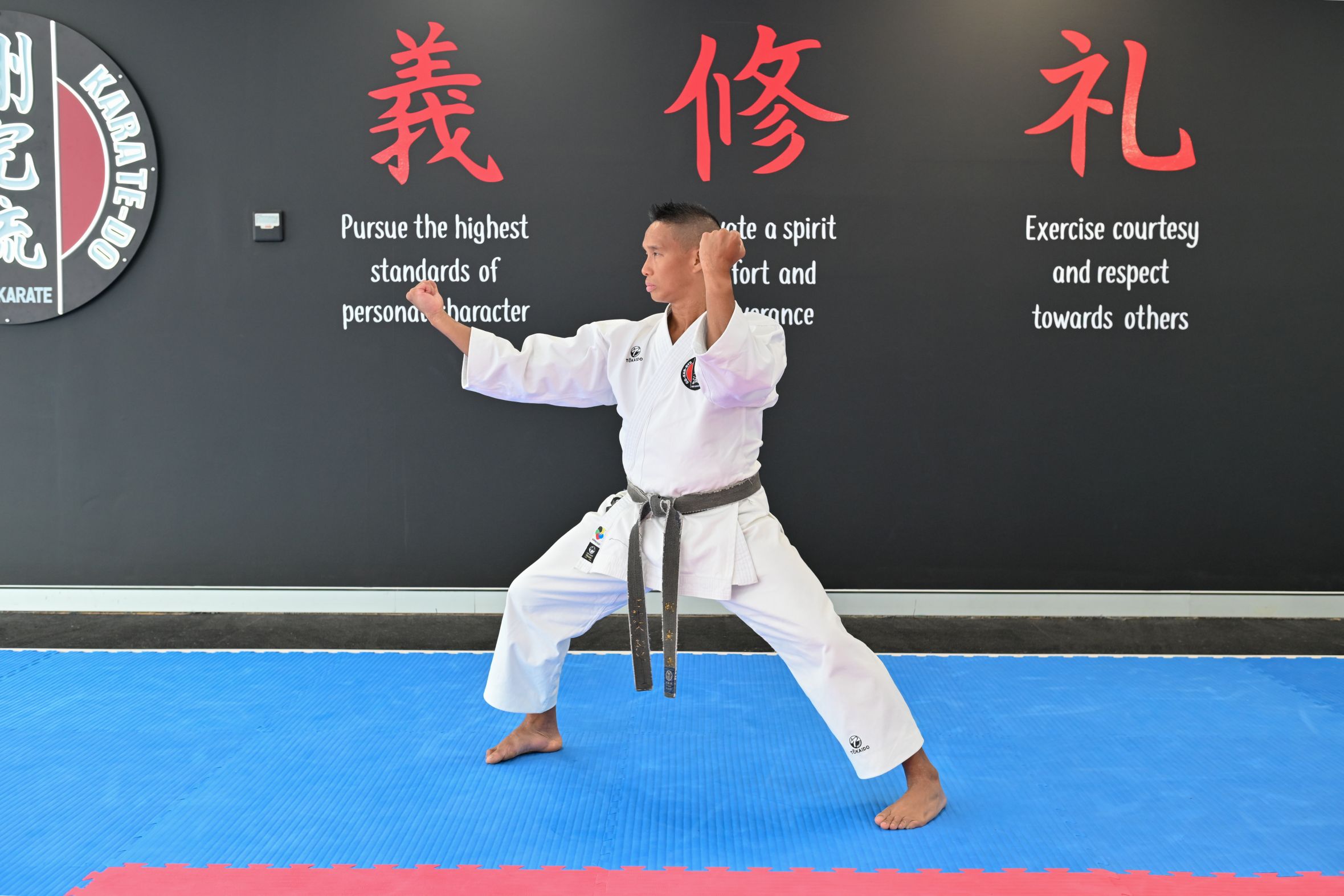
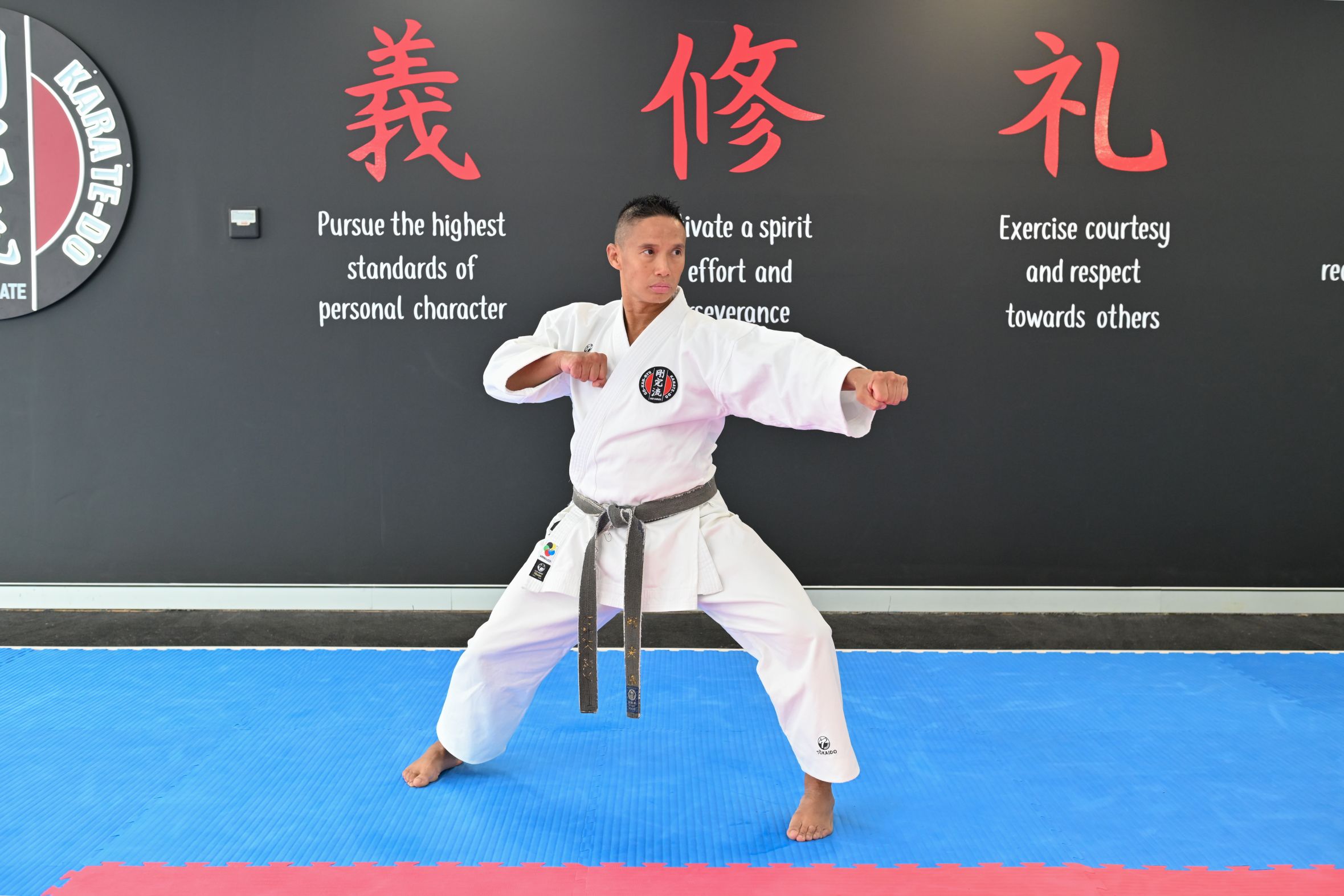
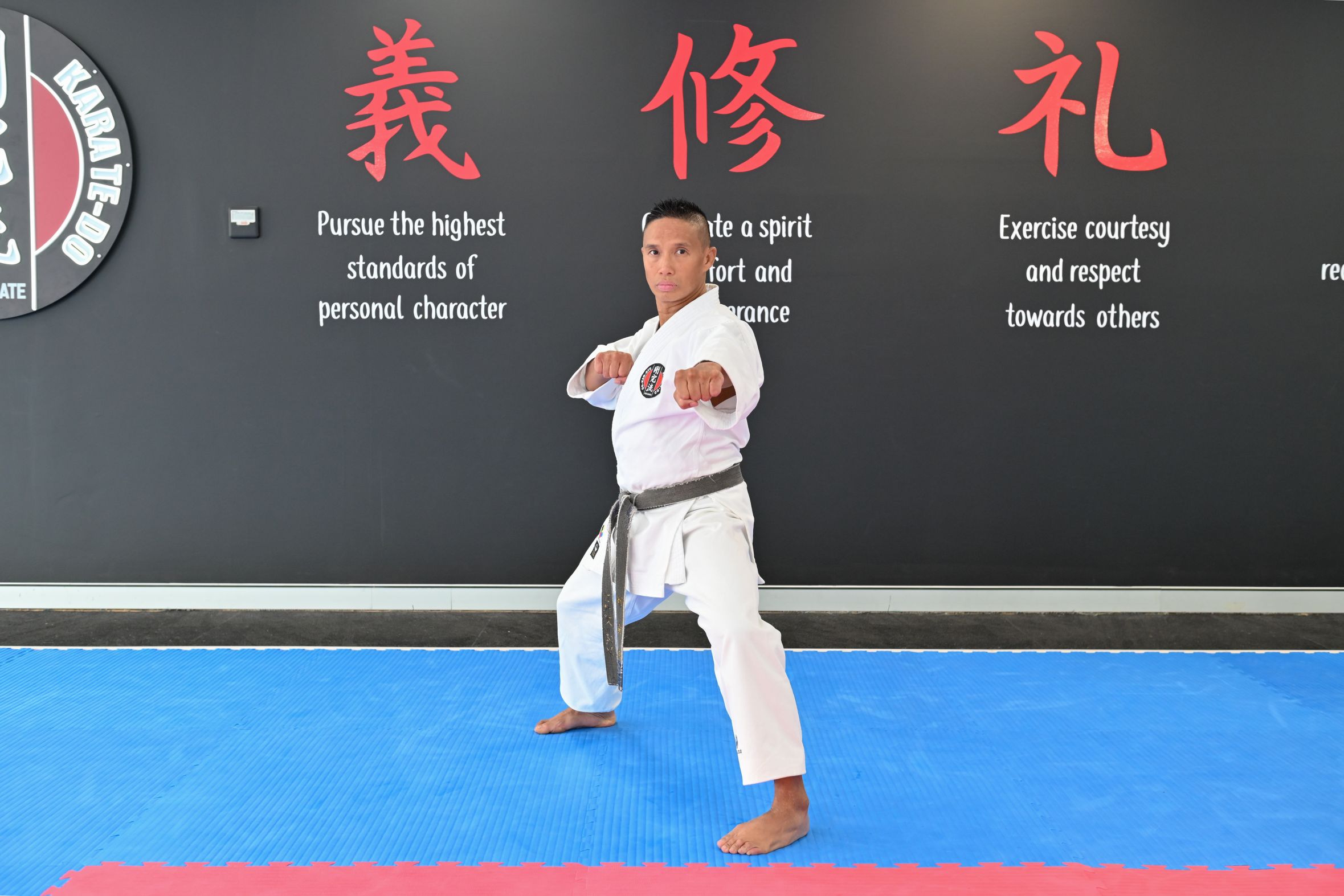
Sochin is introduced to GKR students at Sandan (3rd dan), along with kata Seisan. The rhythm of this kata is slow deliberate movements, interspersed with dynamic outbursts of speed. Sochin is unique as it is the only Go-Kan-Ryu kata that utilizes the long fudo-datchi (rooted or immovable stance) in place of a zenkutsu-datchi (long forward stance).

While GKR’s two Sandan kata (Seisan and Sochin) both hail from Naha in Okinawa and were once quite similar, the way they are practised today sees them vastly different in style and technique. Sochin is a typical Shuri-te, Tomari-te (or later Shotokan) style kata with long, deep stances (primarily using fudo-datchi – immovable stance).

Sochin promotes constant forward movement irrespective of whether one is striking, blocking, wrestling, locking up etc. This is illustrated very clearly in the opening sequence of Sochin, where, like Seisan, it practices consistent forward movements with slow deliberate techniques while keeping the core muscles tense.


GKR Karate – Sochin


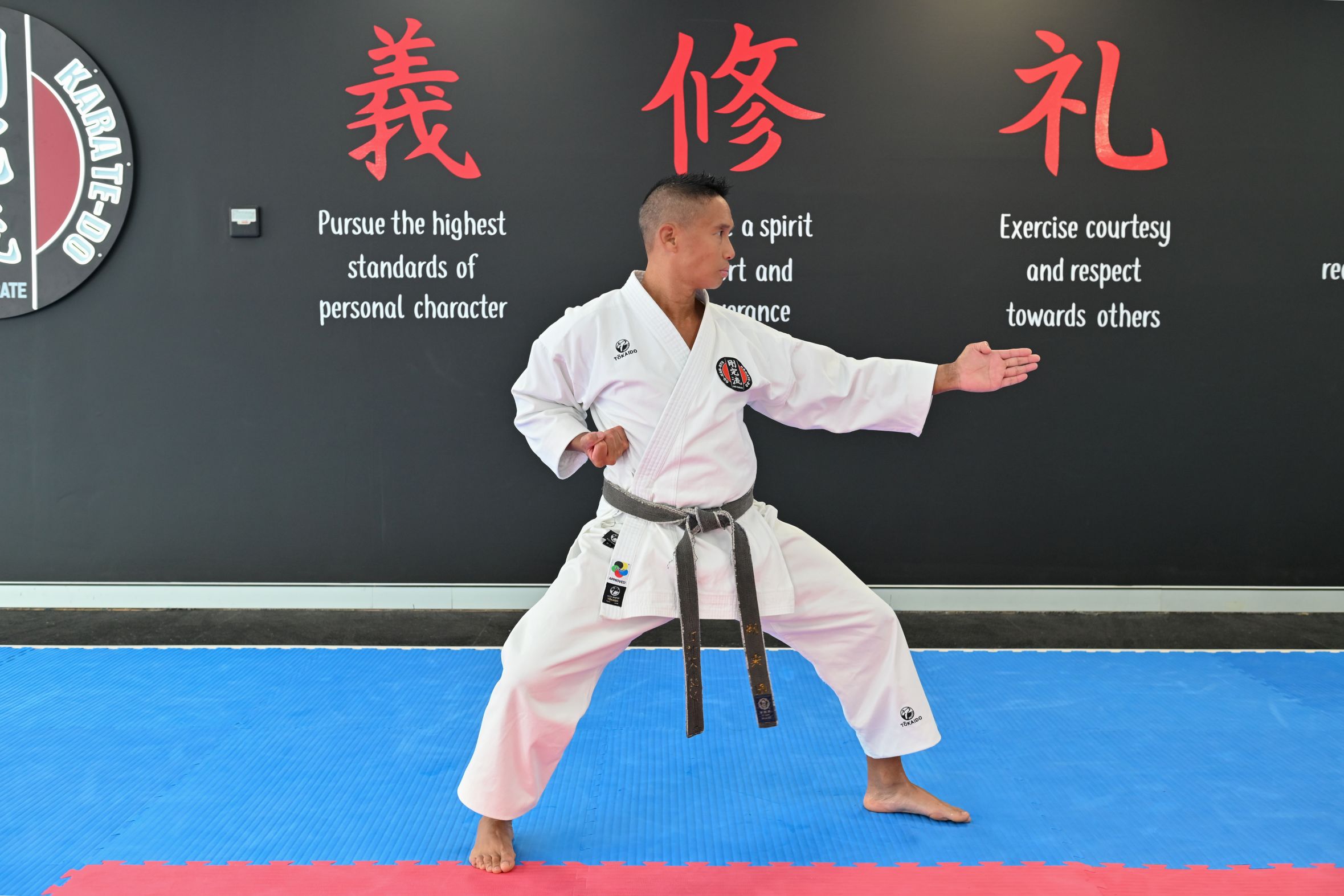
  • Kata Tip: Fudo Dachi (Immovable stance)


    • Fudo dachi is unique to Sochin kata. As such, it is often called Sochin dachi, the same way Hangetsu dachi is also named after the kata it is unique to.
    • Fudo dachi means immovable stance, or rooted stance, because one should feel rooted to the ground. Because of this, the angle of the feet can be altered slightly to help the practitioner feel what is right for them.
    • Generally speaking, the front leg is similar to a Zenkutsu dachi, however the front foot is turned in.
    • The back leg also has similarities to Zenkutsu dachi, however the back leg is bent and the back foot does not have be turned in as much as a Zenkutsu dachi (if the practitioner feels stronger on a slightly different angle).
    • Having the back leg bent and the hips 45 degrees means any punch that comes from it will have the power of the legs and the hips, where Zenktsu dachi only has the power of hip rotation.
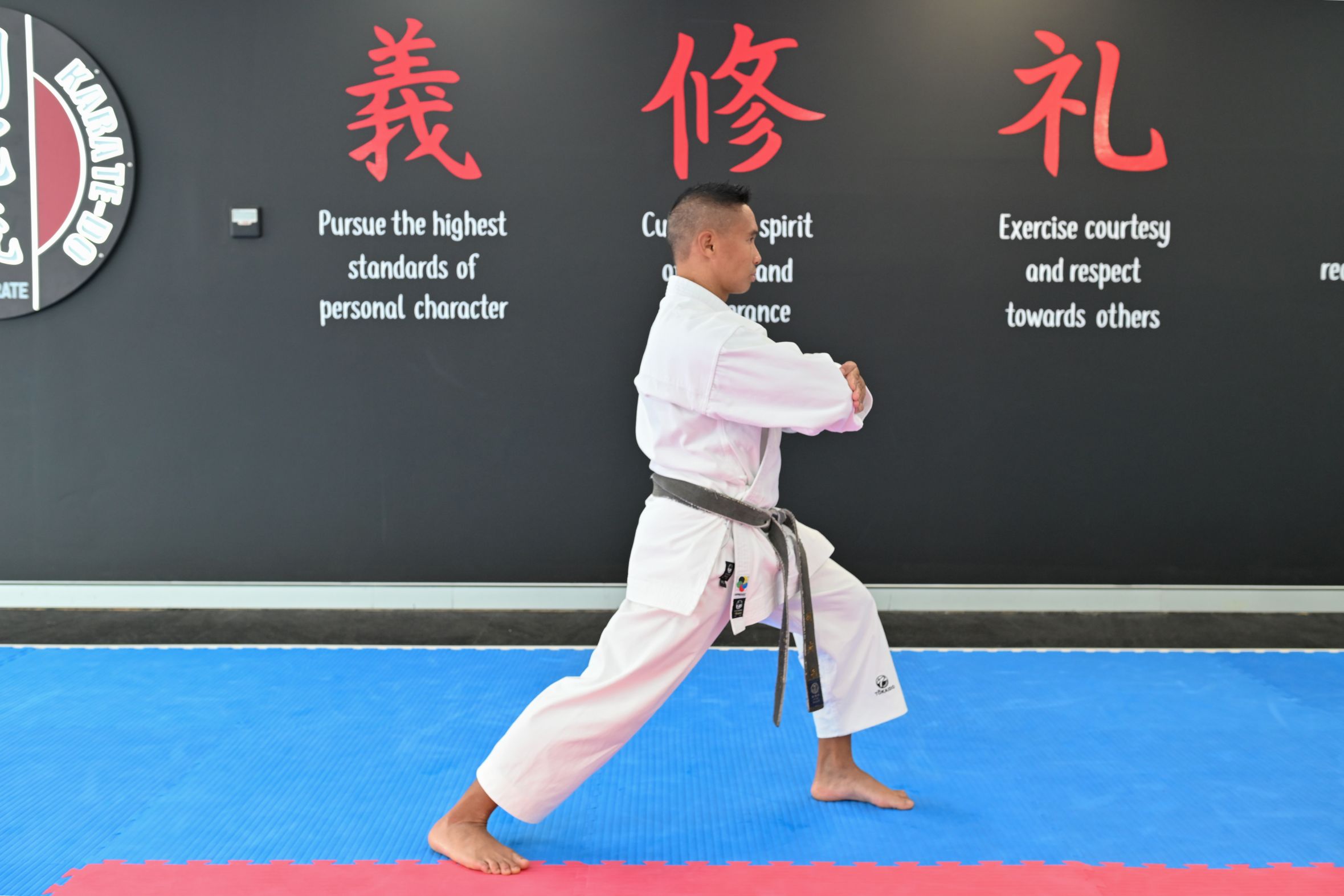
  • Count 1: Stepping from Heiko dachi (parallel stance) to Fudo dachi (Immovable stance)


    • Moving to Fudo dachi from Heiko dachi requires a certain chain of movements.  
    • First, drop the bodyweight by bending the knees and rotating the hips back so that the belt notch points down on a 45-degree angle (similar to the hip position in Neko ashi dachi).  
    • As the body weight drops, the right leg begins its step out to Fudo dachi.  
    • The right leg will first move out WITHOUT the body following, so a mid-way point would look like a Neko ashi dachi, with the hips square and weight over the left leg.  
    • Once the right leg moves past Neko ashi dachi, the body starts its journey forward, keeping the hips square. This means the hips can rotate back to 45-degrees at the end of count 1.  
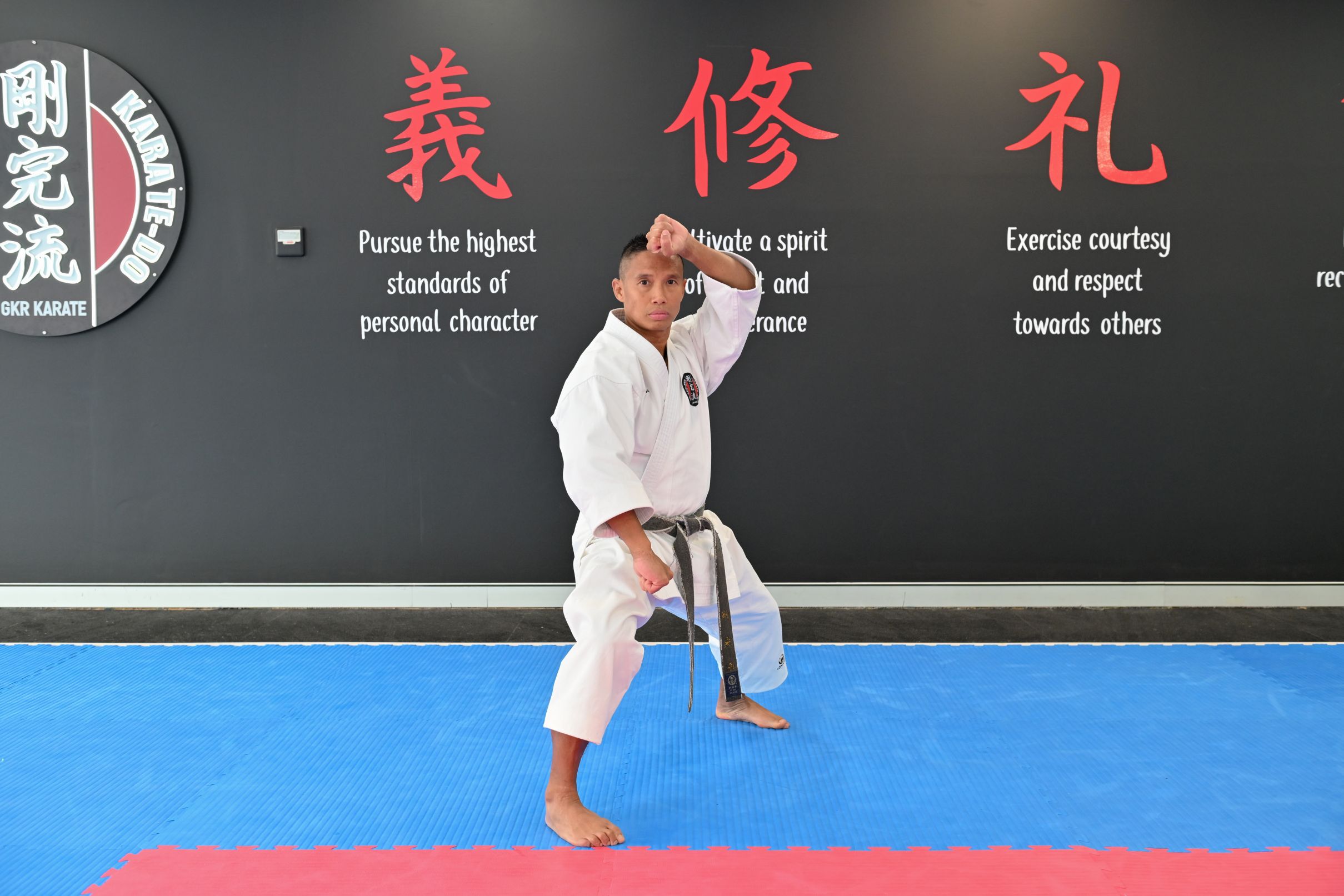
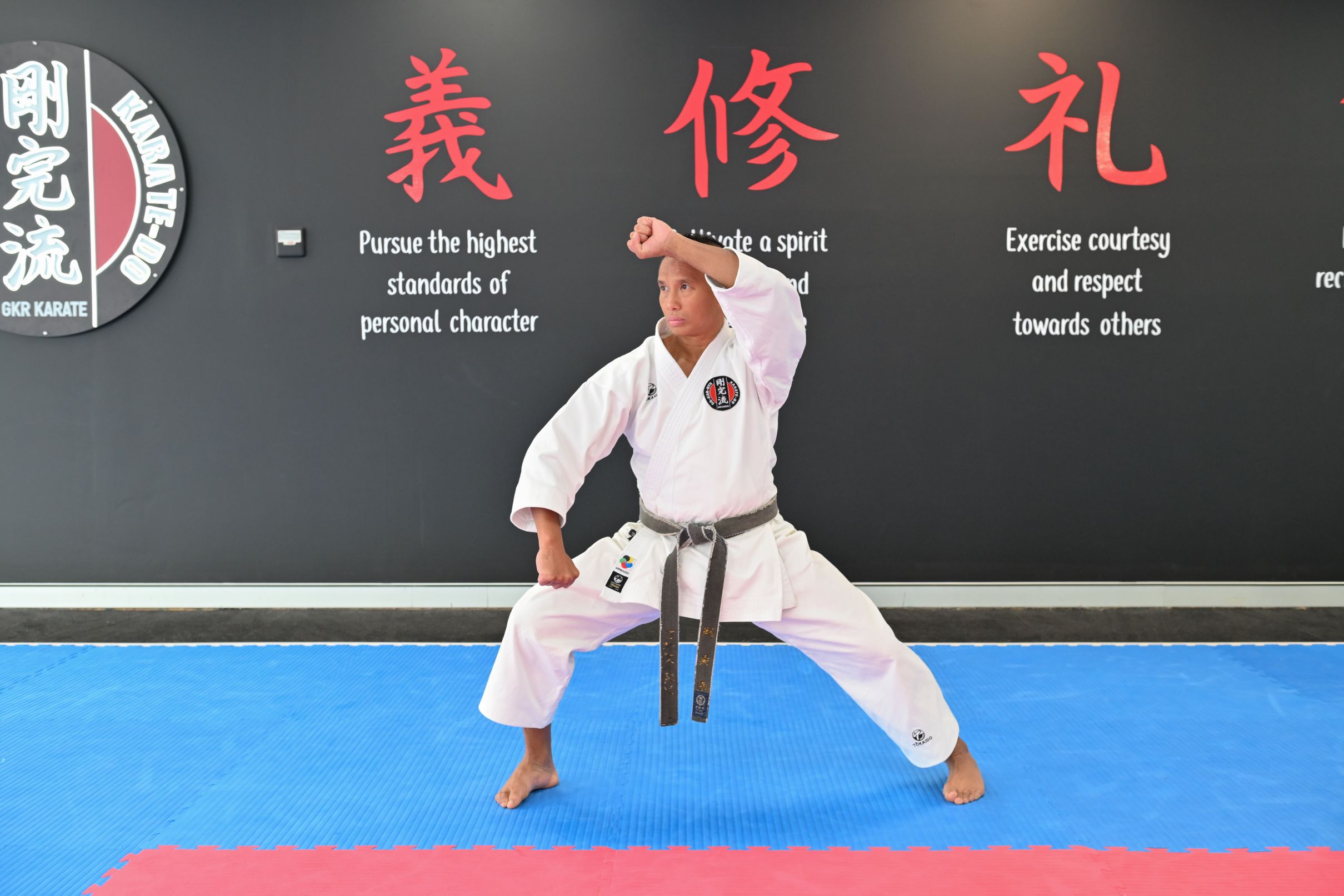
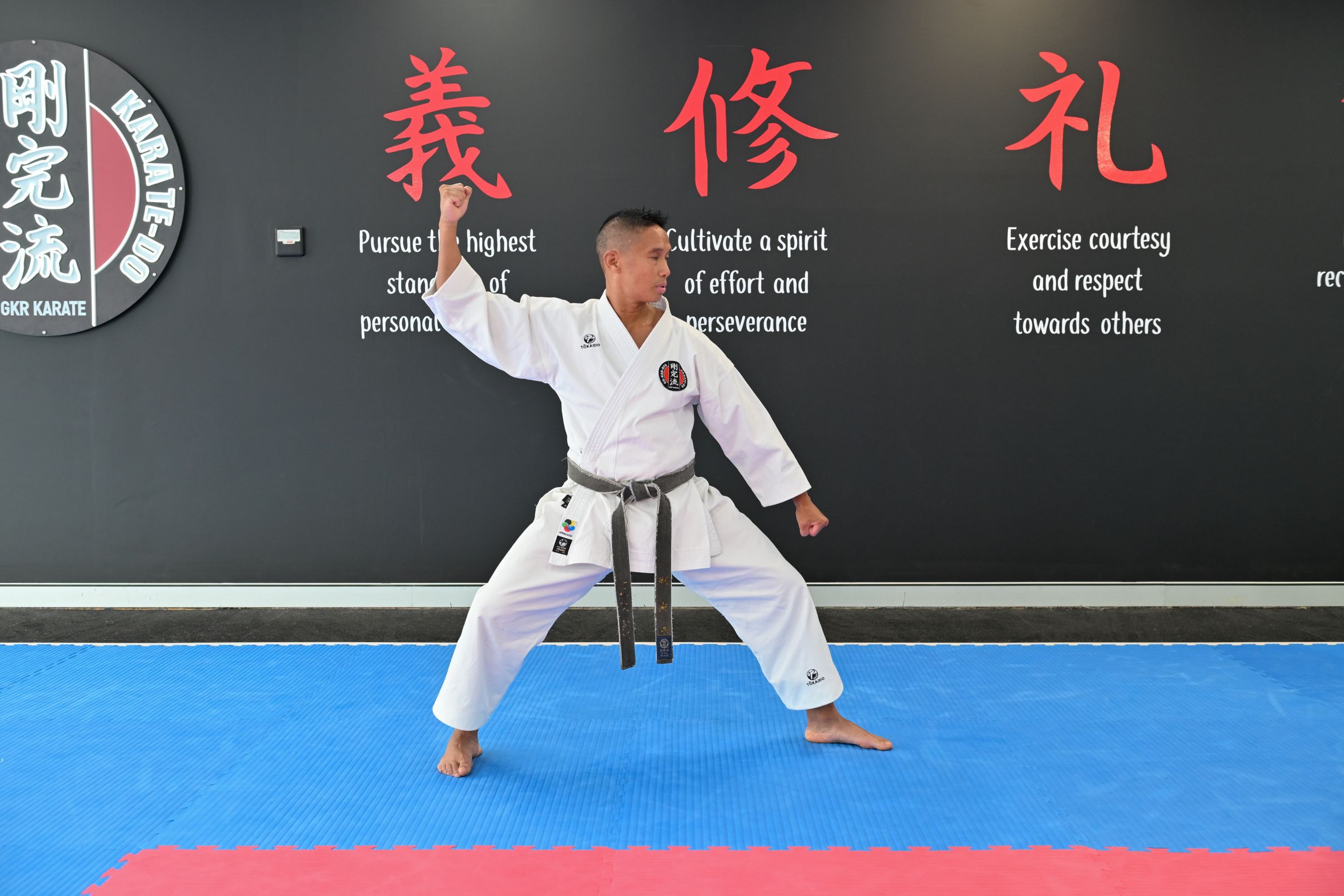
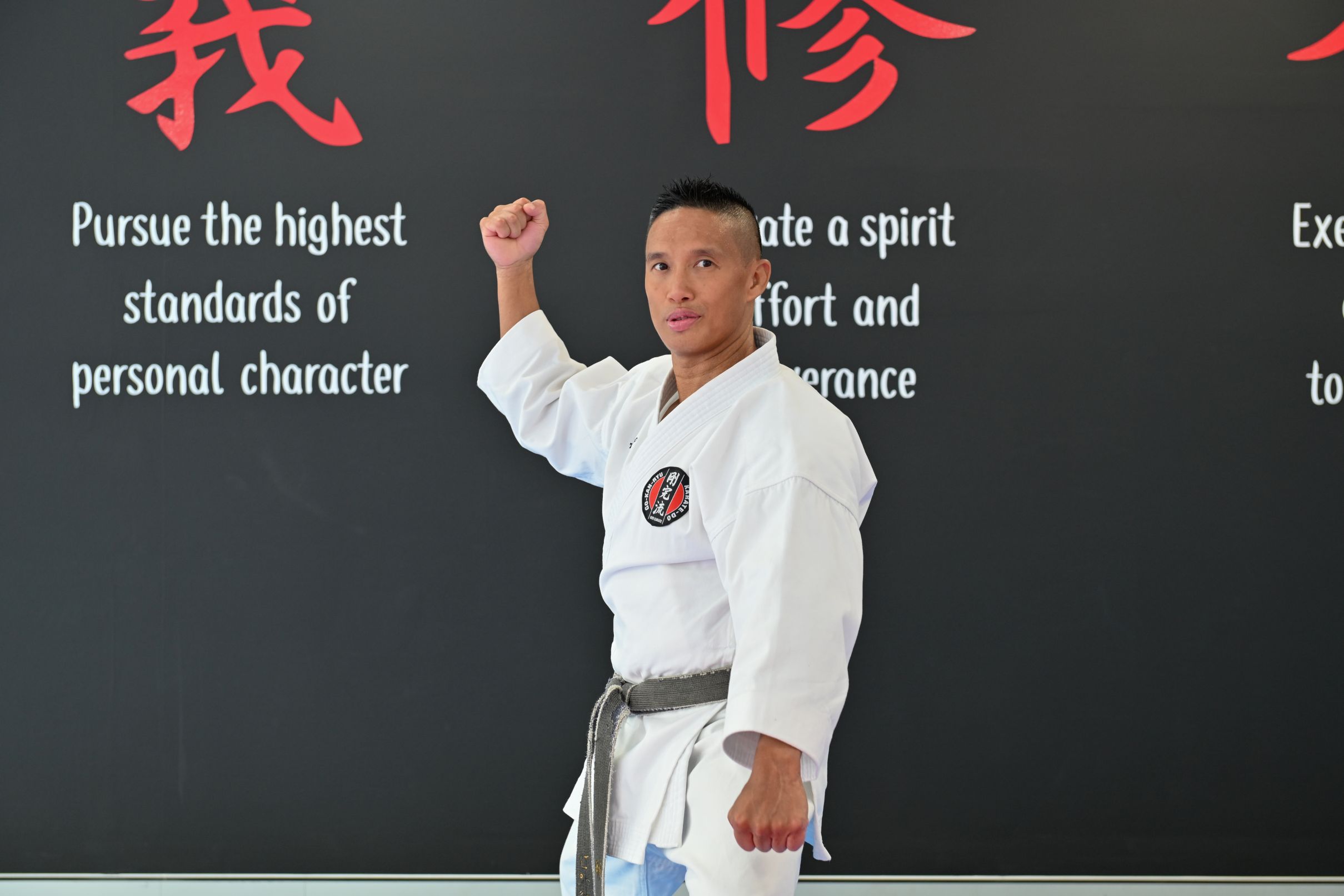
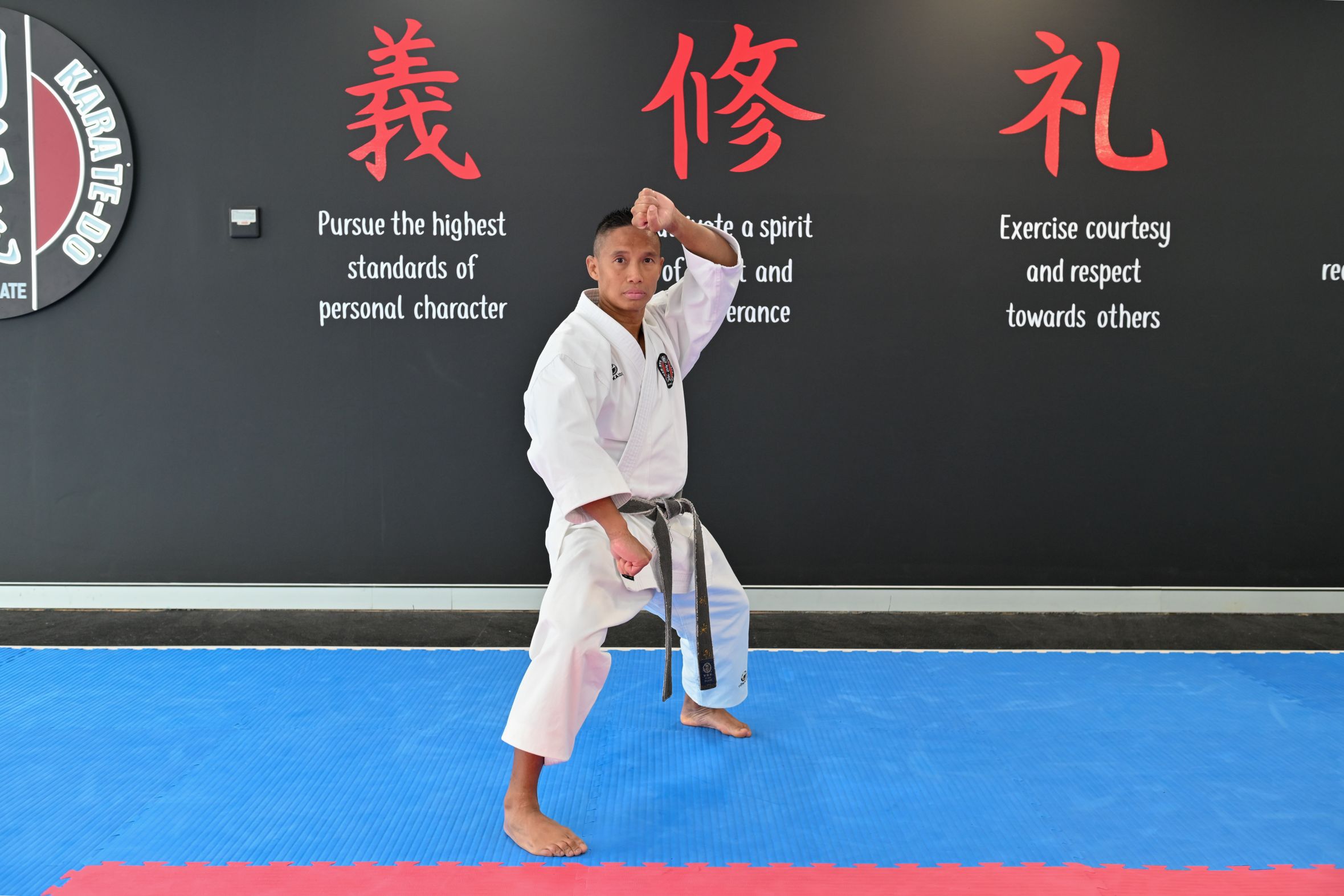
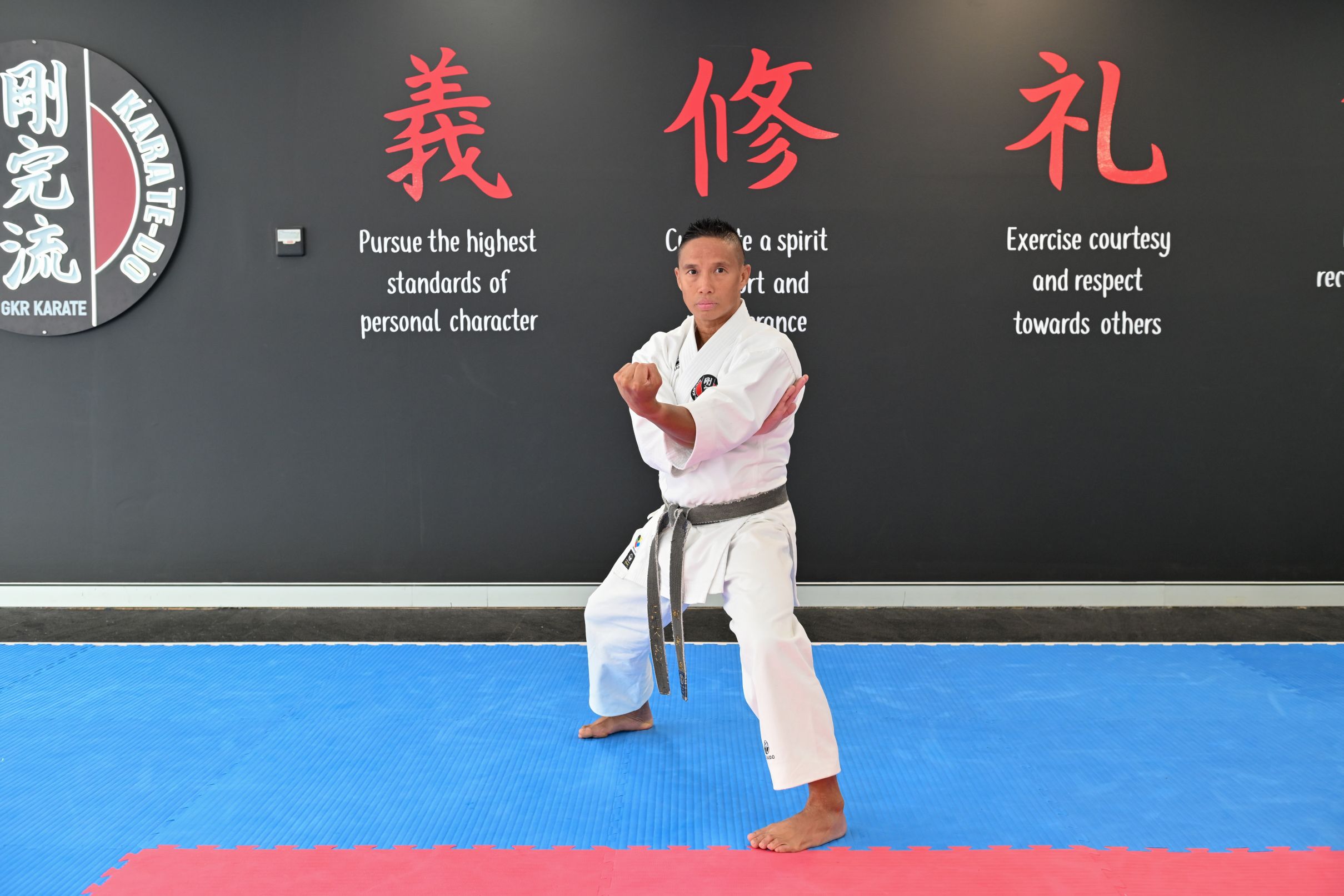
  • Counts 1, 5, 9 and 22: Jo-ge (head-groin) Sen-no-sen (simultaneous block and strike) in Fudo dachi (Immovable stance)


    • While it is referred to as Sen-no-sen (simultaneous block and counter) in the kata, i.e. blocking the head while simultaneously striking the groin with a Tetsui hammer-fist, this is an unlikely application. Liken this to an Uchi uke in a kata, where we call the technique “Uchi uke” (inside hooking block) but the application is rarely a block.
    • For the kata aesthetic, the upper arm is performing a Jodan age uke, however does NOT use the standard kihon preparation. Rather it uses a harai (sweeping) circular motion, starting low with the fist pointing down. This is often seen as getting underneath an opponent’s grip to lever it upwards (making contact with the upper arm, not the forearm or hand).
    • The Tetsui also takes a larger Harai (sweeping) motion, starting higher (fists pointing vertical) to then circle down and strike the groin, finishing facing 45-degrees forward. This is often interpreted as coming up to get above an opponent’s grip and lever downward.
    • There should be two simultaneous twisting movements at the end of these counts; the twisting of the hips into Hanmi (45-degree) position with the twisting of the forearms and wrists as the blocks finalise.
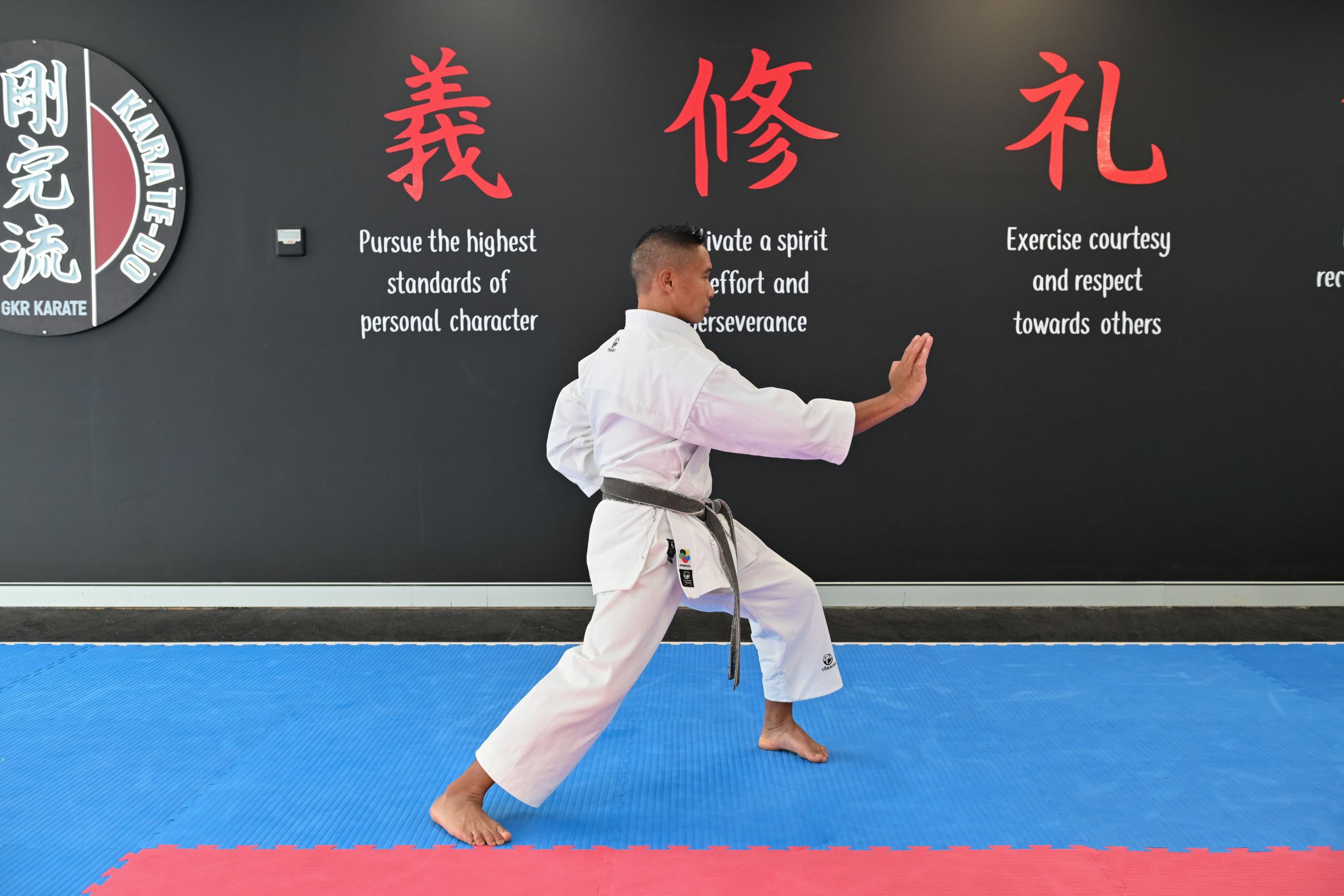
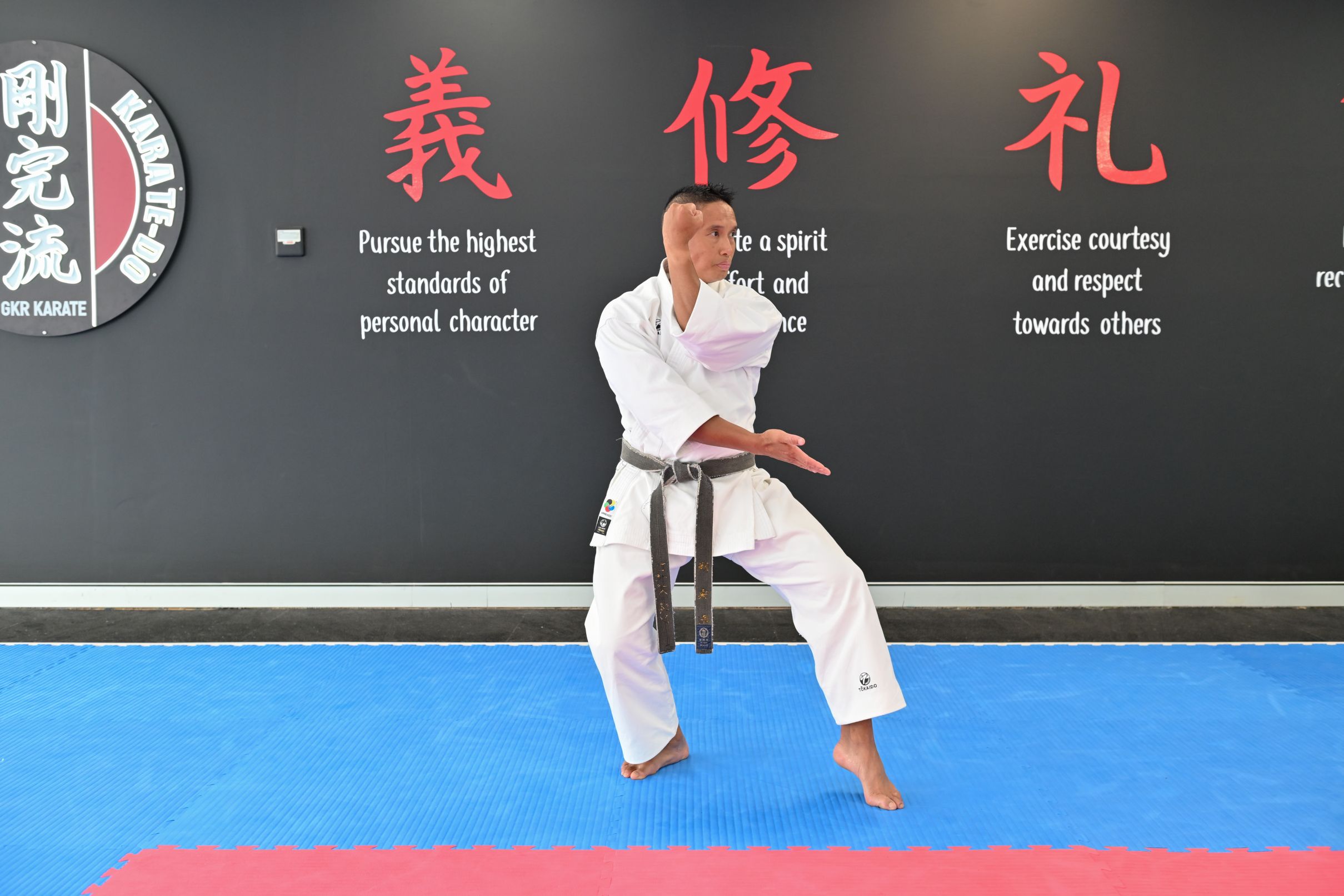
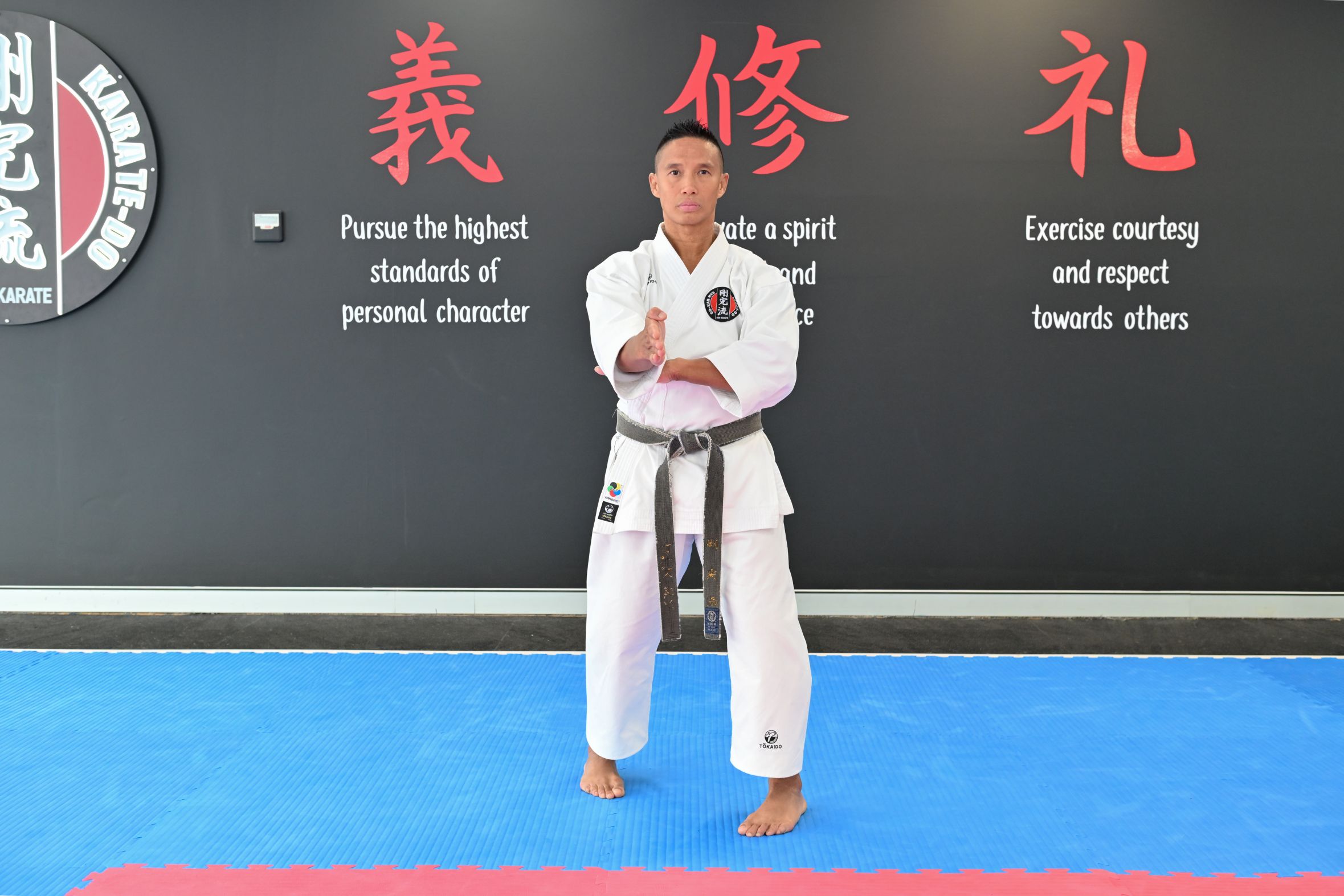
  • Counts 2, 6 and 10: Preparation before Taisho uke (Palm-heel block)


    • Counts 2, 6 and 10 of Sochin are quite intricate so we are breaking down the preparation phase of this movement.
    • Count 1 finishes with the hips pointing 45-degrees to left hand side of the dojo. Count 2 finishes with the hips square to the front, but uniquely, during the preparation phase the hips switch 90 degrees across to face a 45-degrees to the right-hand side of the dojo, prior to ending square.
    • From count 1, the upper arm (left) drops its elbow down and in to cover the centre. The palm turns up to assist this elbow covering the centre. This creates more power for the elbow to compress and opponent’s grip.
    • As the left elbow drops in and across, the lower hand (right) will raise and come underneath the left arm. The wrist comes underneath the armpit with the palm turned out and fingers pointing up.
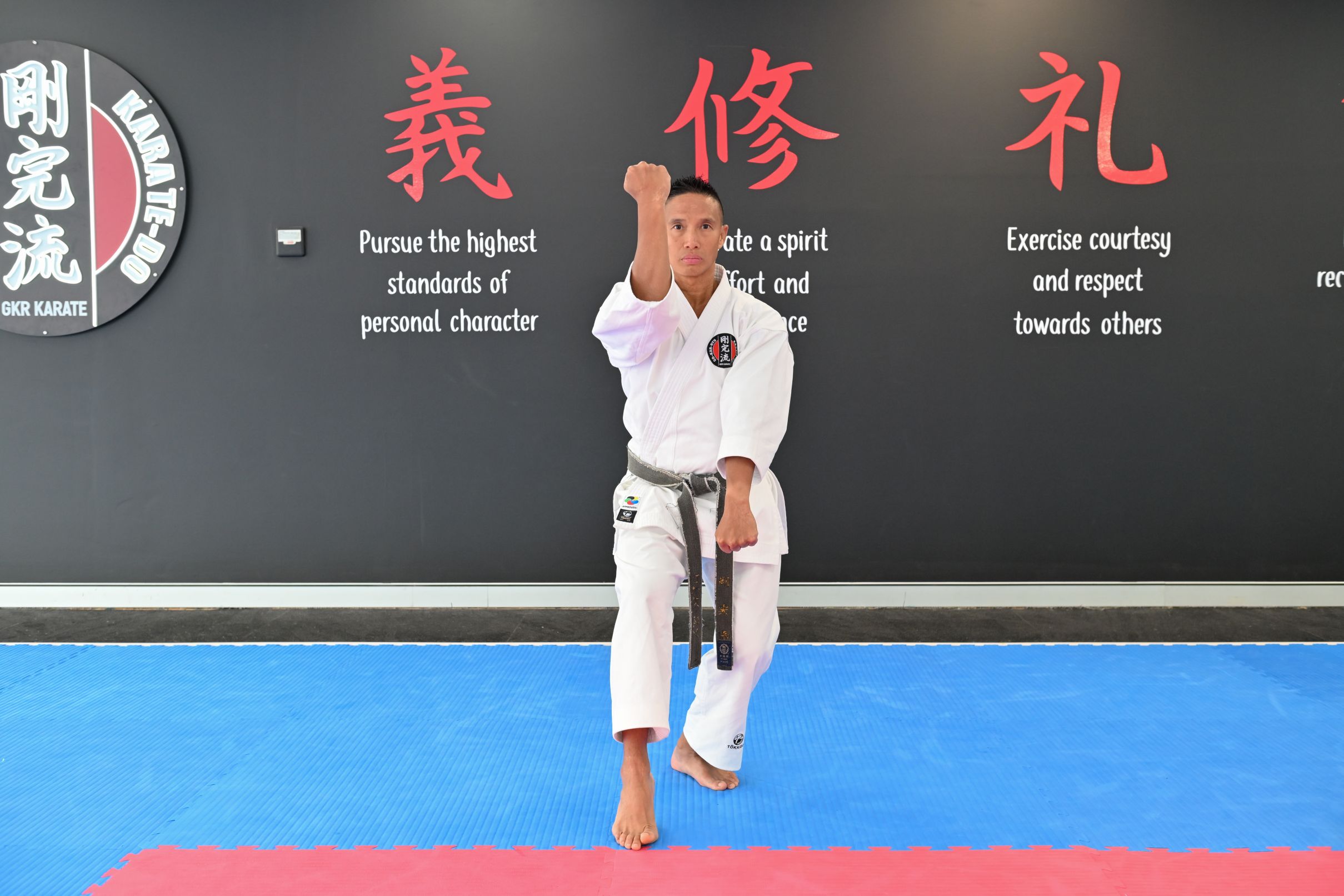
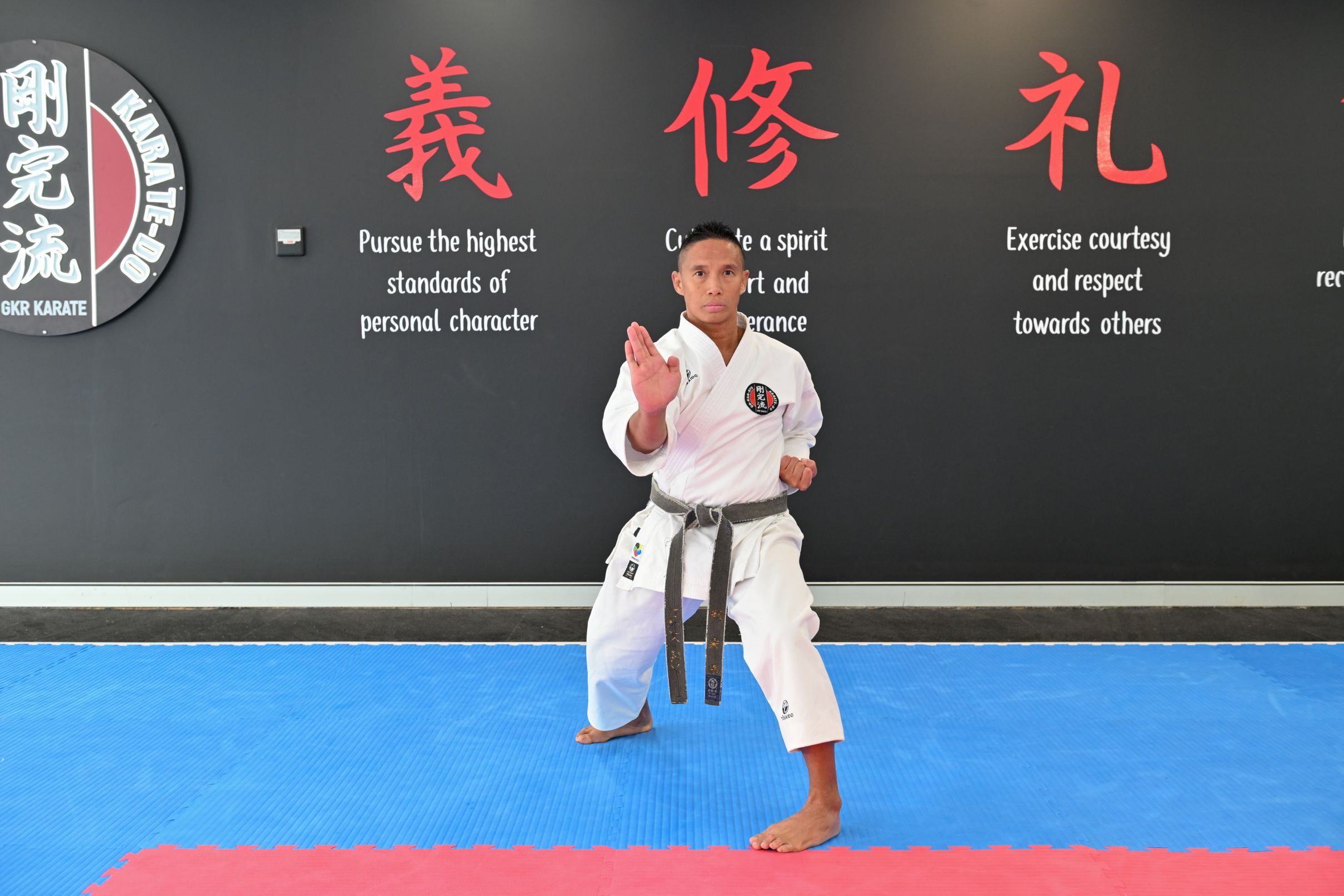
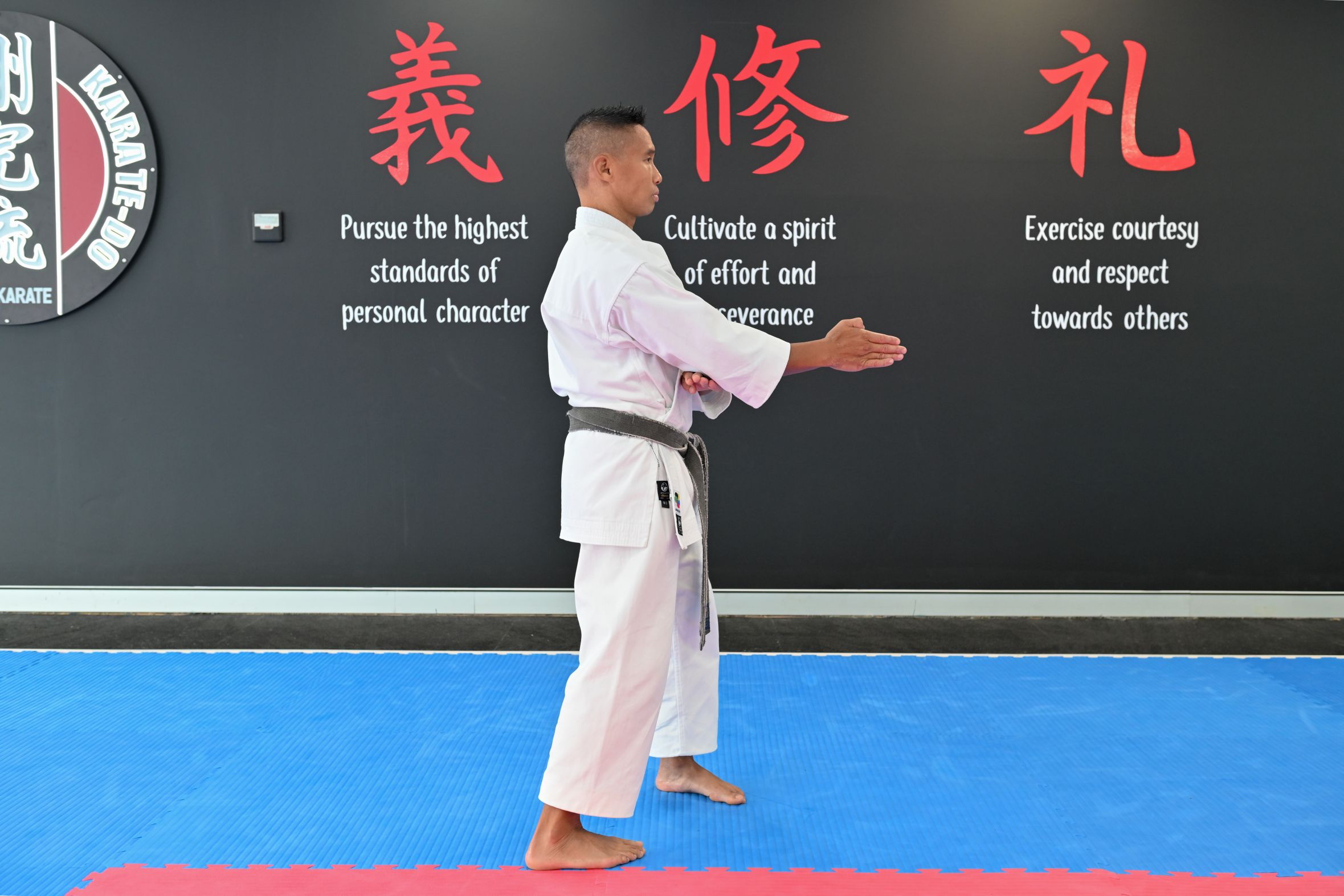
  • Counts 2, 6 and 10: Execution of Taisho uke (palm-heel block)


    • The preparation phase for Taisho uke has the wrist under the arm pit. To execute Taisho uke, the hand slides along the outside of the extended arm.
    • Once the right-hand Taisho is almost fully extended, it will cut across and finish with the palm heel in front of the right shoulder. The fingers may be slightly above the right shoulder.
    • The Taisho arm is bent, but only slightly, with the elbow behind the palm-heel, but equally, below it. In other words, the elbow should not stick out to the side.
    • The Hikite hand pulls back to the traditional position as the Taisho is extending out.
    • The hips finish square by the time the Taisho has completed.
  • Counts 4 and 8: Preparation for Manji uke (vortex block)


    • Once again, we will focus on the details of a preparation prior to its execution.
    • Count 3 ends with the left leg forward in Fudo dachi. Count 4 sees the left leg move perpendicular left into Kokutsu dachi. The journey between the two does not require the feet to come together, rather the left leg making an arch. The weight shifts back to the right leg, allowing the left leg to move freely, and it will by-pass through a Neko ashi dachi.
    • As the left leg begins to move, the head turns to look left and the right hand points to the direction the leg wishes to go (palm upward).
    • While the left arm will execute a Gedan barai, it does NOT prepare via the standard kihon version. The block is more akin to a Harai uke (found in Seiunchin and Sepai), where the hand prepares head level and the elbow moves across the face prior to blocking.
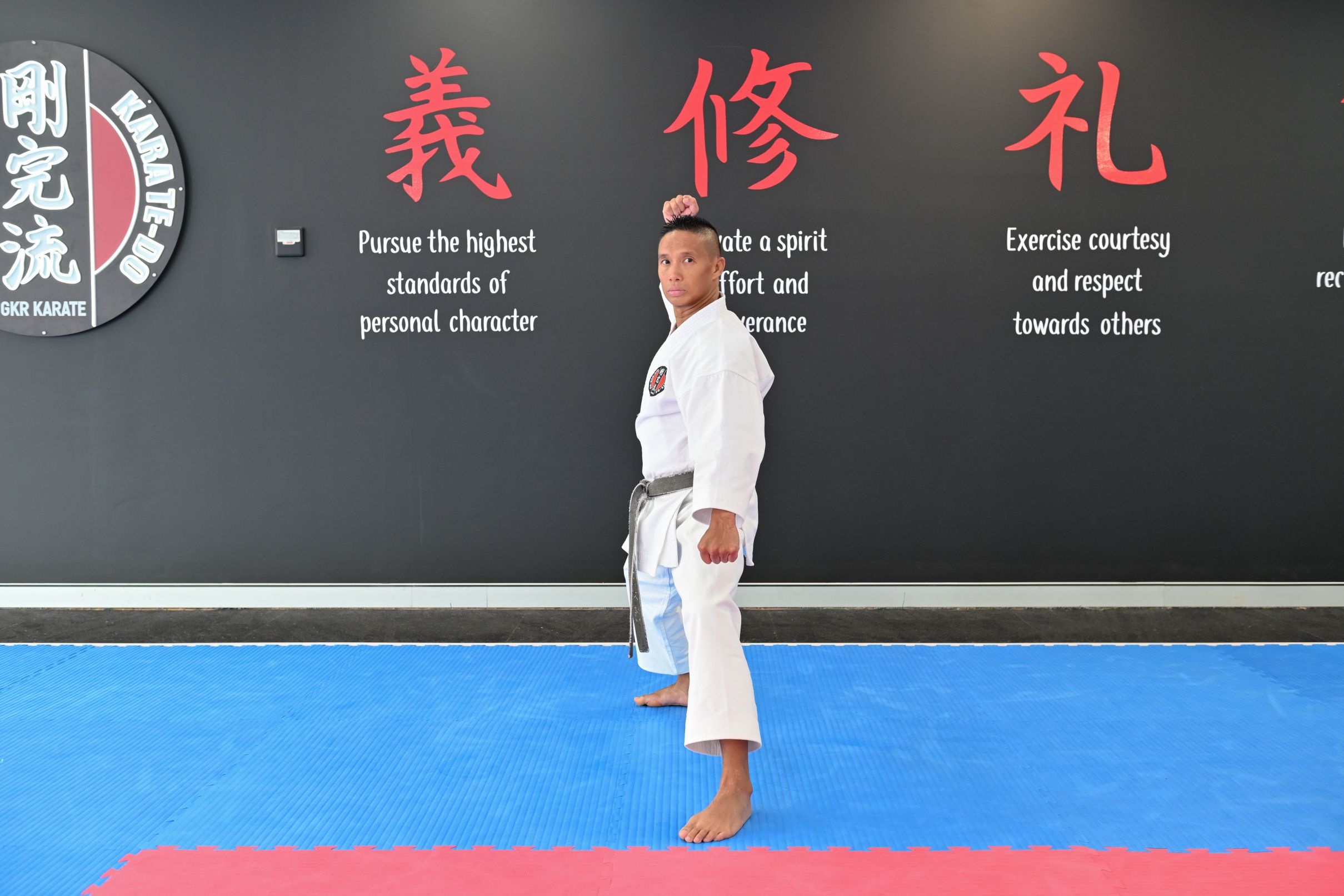
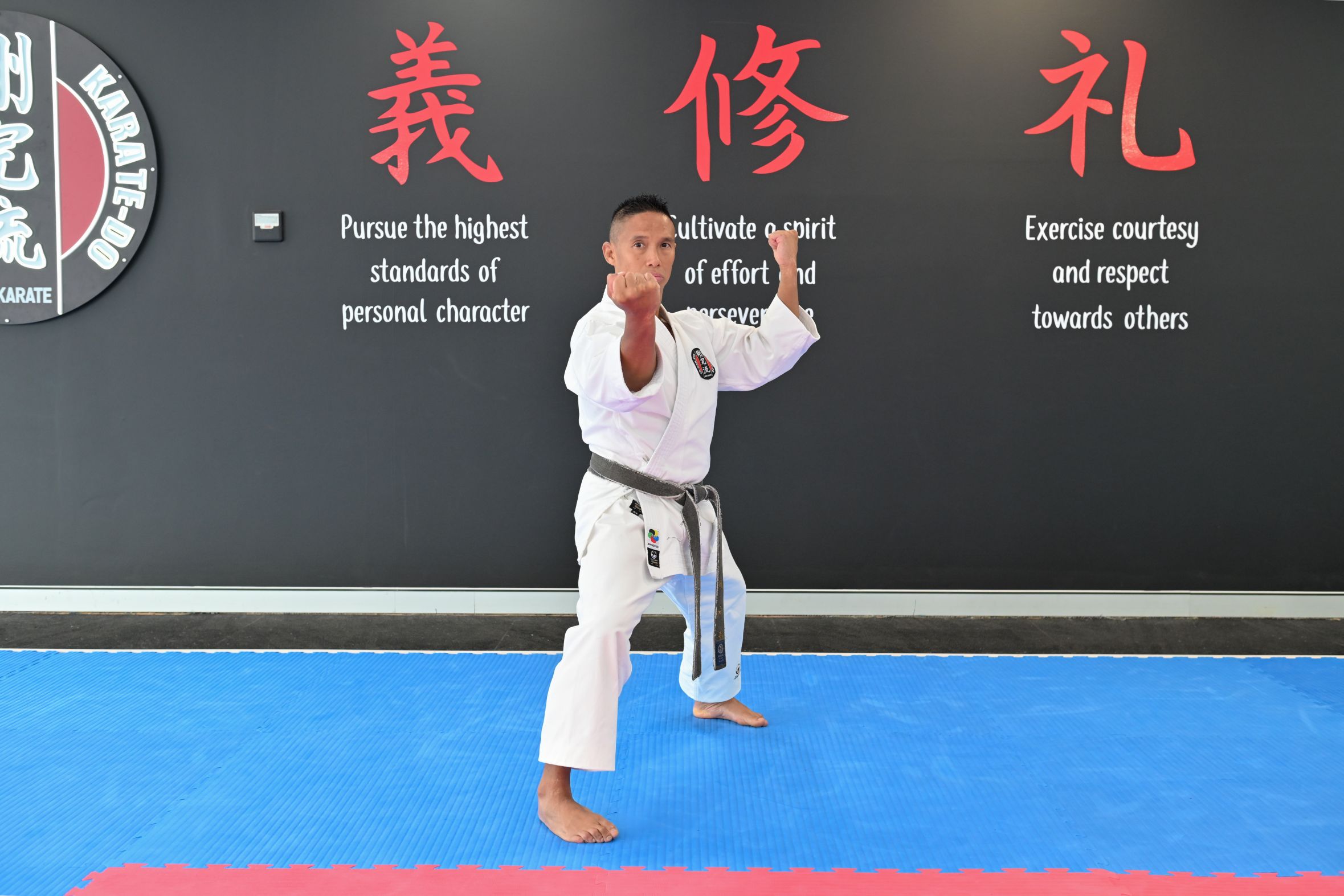
  • Counts 4 and 8: Execution for Manji uke (Vortex block)


    *last photo is acceptable if the student is unable to get their rear arm behind their head.

    • Manji uke (vortex block) is a combination of a Harai uke (a circular Gedan barai, found also in Seiunchin and Sepai) with an Ushiro jodan uchi uke (backward, head-level inside hooking block).
    • The rear, upper hand finishes at a right angle, with the elbow in line with the shoulder and the fist directly above the elbow.
    • The rear hand ideally finishes directly behind the head, with the fist visible above (like the Manji uke found in kata Bassai-dai). However, if a student has flexibility issues in their chest or shoulders, it is acceptable to have the rear hand to the side of the head, as far back as possible.
    • The Harai uke, despite its circular preparation, finishes in the identical position to a Gedan barai.
    • Manji uke is called vortex block due to the technique’s rotational nature, designed to capture and control an opponent by trapping, pulling motion (like being sucked into a vortex). It’s also because of the shape of the arms and legs, resembling the Buddhist symbol 卍, representing harmony and balance.
  • Counts 5 and 9: Preparation for Jo-ge (head-groin) Sen-no-sen (simultaneous block and strike)


    • The Jo-Ge sen-no-sen is reached on count 1 via Heiko dachi. Counts 5 and 9 however find the block via a Kokutsu dachi.
    • Kokutsu dachi has the weight two thirds back, which means one can generate enormous power driving forward into their Fudo dachi. Staying the same height and transferring energy from the back leg to the front will ensure full power is achieved. 
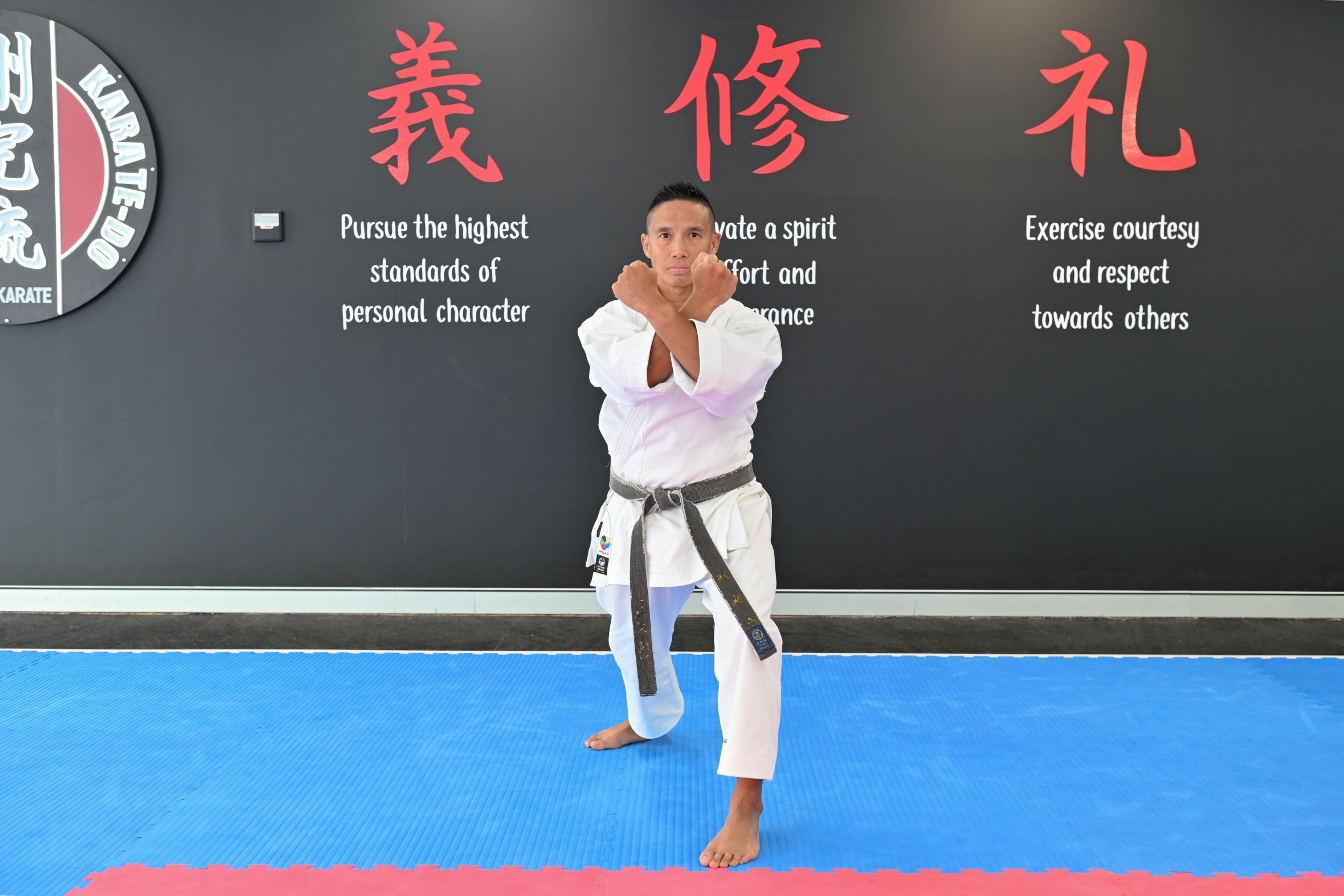
    • As the weight is thrown onto the front leg, the forearms cross out in front of the body. The upper arm (right) drives in a circular fashion towards its Testui (hammer fist) while the lower arm (left) raises in a circular fashion towards its Jodan uke. They will cross during this process.
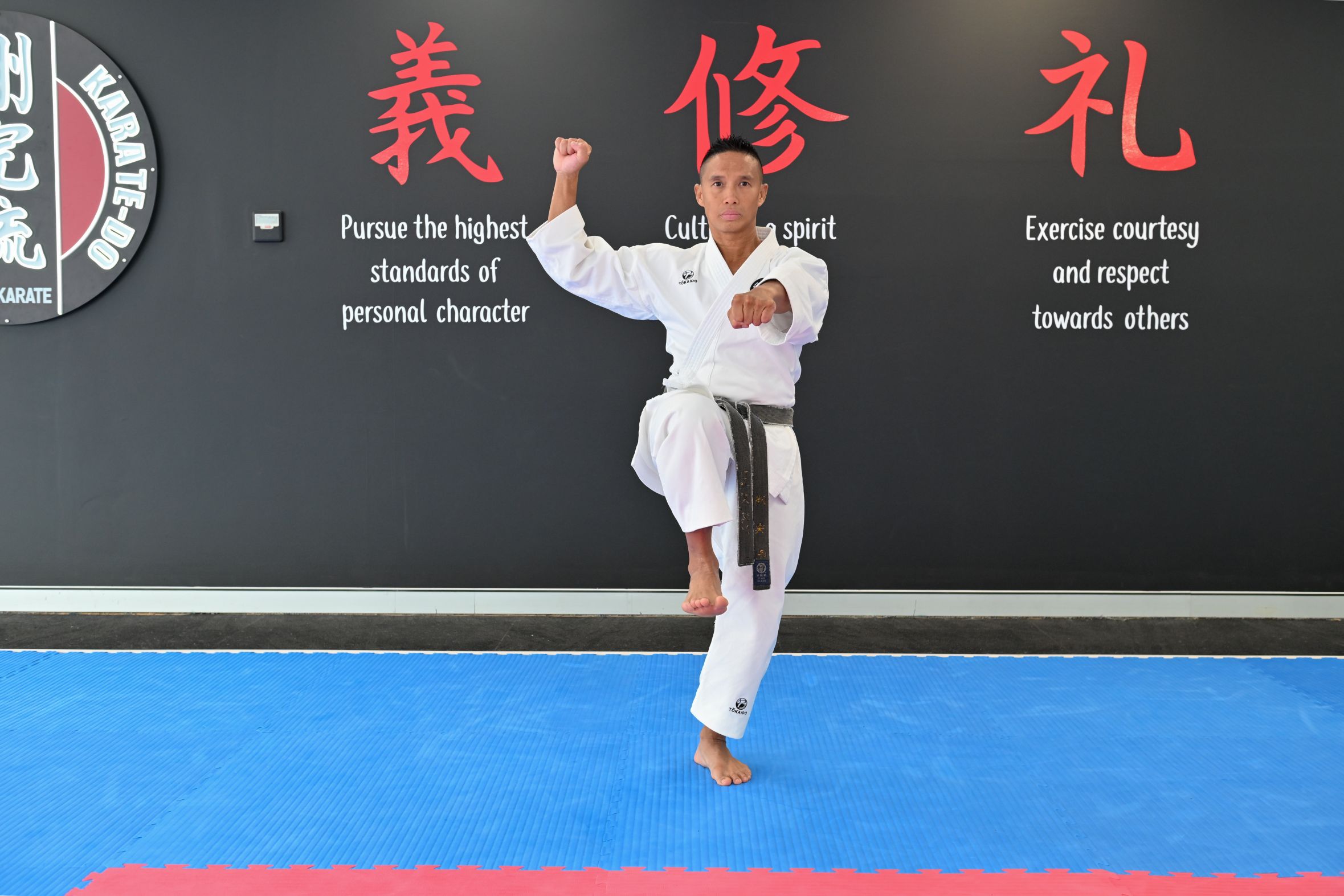
  • Counts 11 and 12: Mawashi Emp


    • A side kick precedes both elbow strikes in counts 11 and 12, its therefore important to get the preparation correct to ensure the elbow strikes have maximum power.  
    • After kicking, keep the weight over the base leg, allowing the opposite foot to step out to the length of Zenkutsu dachi without the weight following. This will resemble a Kokutsu dachi (but a shoulder-width wide), and means you will be able to thrust the bodyweight forward into the elbow strike.  
    • The backfist prior will open the hand as if to grab an opponent. The preparation point of the hand will be palm inwards and sit lower than the shoulder.  
    • As we thrust out weight forward, the hands work in a push-pull fashion. With the extended open hand pulling in to meet the elbow strike on its way out.  
  • Count 20: Yon-Hon Nukite (4 finger spear-hand strike)


    • Count 19 finishes with the left leg forward in Kokutsu dachi. Count 20 finishes with the left leg forward in Heiko sanchin dachi, which has the same components to a regular Sanchin dachi, however the front foot is pointed straight, making the feet parallel.
    • To move into count 20, we use Yori ashi (sliding feet) footwork. The front (left) foot slides forward, then the rear (right) foot slides up behind.
    • As the front foot moves and the body starts to come forward, the open right hand will move to the floating ribs (hikite position). As the back foot lands, both hands finalise into position with the push down and the strike.
    • The left hand pushes down but also comes in slightly, finishing just behind the elbow of the right hand with the palm pointing down.
    • The chudan Yon-hon nukite pushes out in a straight line (it does not aim to the centre). The arm remains bent and the palm faces inward.  
  • Count 21: Sen-no-sen (simultaneous block-counter) with Jodan Tetsui (head-level hammer-fist) and Jodan Uchi Uke (head-level inside hooking block).


    • Count 20 begins with two Mae Geri (front kicks). During this process the hands remain firmly in place with the Yon-hon nukite.
    • After the second kick, the Yon-hon nukite (right hand) pulls back like it is preparing for Soto uke, at a right angle. If it is not exactly at a right angle, this is ok, so long as the forearm is still directly above the elbow.
    • After the second kick, the left-hand closes and extends directly out in front. This can be seen as grabbing an opponent to pull in, or even to control distance.
    • The hips remain directly to the front until the last possible second, where they snap back to Hanmi (45-degrees) position. This rotation adds reach and power.
    • The right hand moves from its Soto uke-style preparation with a Tetsui (hammer-fist) to side of the jaw.
    • The Hikite hand (pulling hand) in this technique is ripping back, head level and to the side with a jodan Uchi uke. This can be seen as a block, although more realistically it is pulling an opponent inwards, while potentially twisting them on their axis also.  
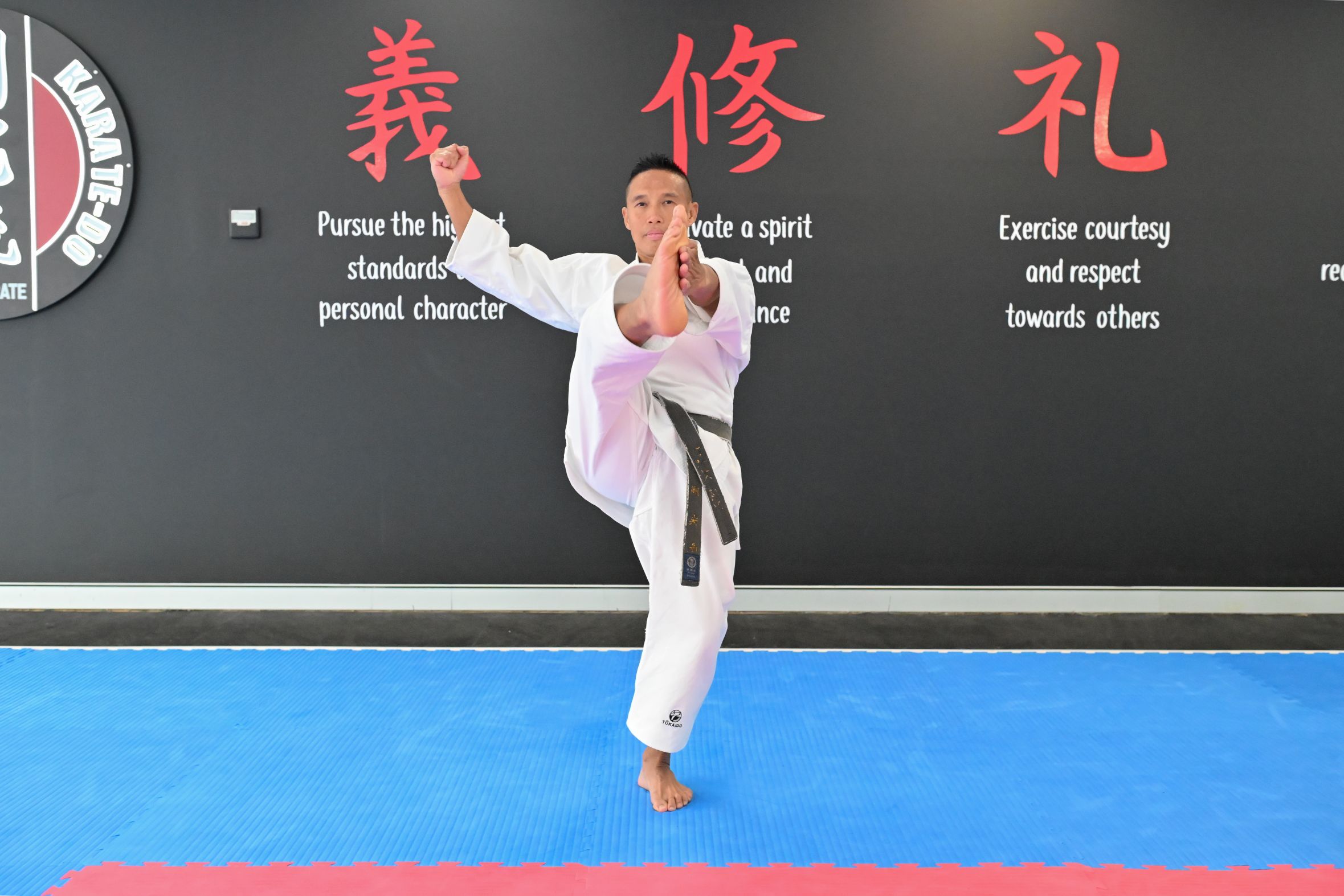
  • Count 22: Mikazuki Geri (crescent kick) with Jo-Ge (head-groin) Sen-no-sen (simutanously block and strike)


    • Count 21 is right foot forward in Fudo dachi, facing the rear of the dojo. Count 22 is also right foot forward in Fudo dachi, however it is facing the front of the dojo. We achieve this via a counter-clockwise spin with a crescent kick in the process.
    • A crescent kick is call Mikazuki geri. Although the word doesn’t mean crescent.  Mikazuki broken down means, “Mi” (three) “Ka” (day) “Zuki” (moon).   A three-day moon is crescent shape, and the kick travels along a crescent path. Three can mean both “san” and “mi” in Japanese, depending on the context.
    • As the kick takes place, the left palm moves down to meet the kick. Kicking the palm with a Mikazuki geri also takes place in Bassai-dai and Hangetsu. Hangetsu breaks down as “Han” (half) “getsu” (moon).  Like the number 3 (“San” or “Mi”) the context depends on which word is used in Japanese. The same applies with moon. The physical moon is called “Zuki”. However “Getsu” (in Hangetsu) is period of time for the moon (like a lunar calendar).
    • As the Mikazuki strikes the left palm, the right hand should prepare like a Soto uke. After the kick, as the foot moves down to Fudo dachi, the right hand circles around to a Tetsui toward the groin. Note both the feet and hands work in a circular crescent fashion.
    • Immediately after the left hand has connected with the Mikazuki geri, it rips up to a Jdan age uke, however it does not need to come to the opposiute should in preparation. Both hands work in circular motions rather than following their trajectory in kihon.
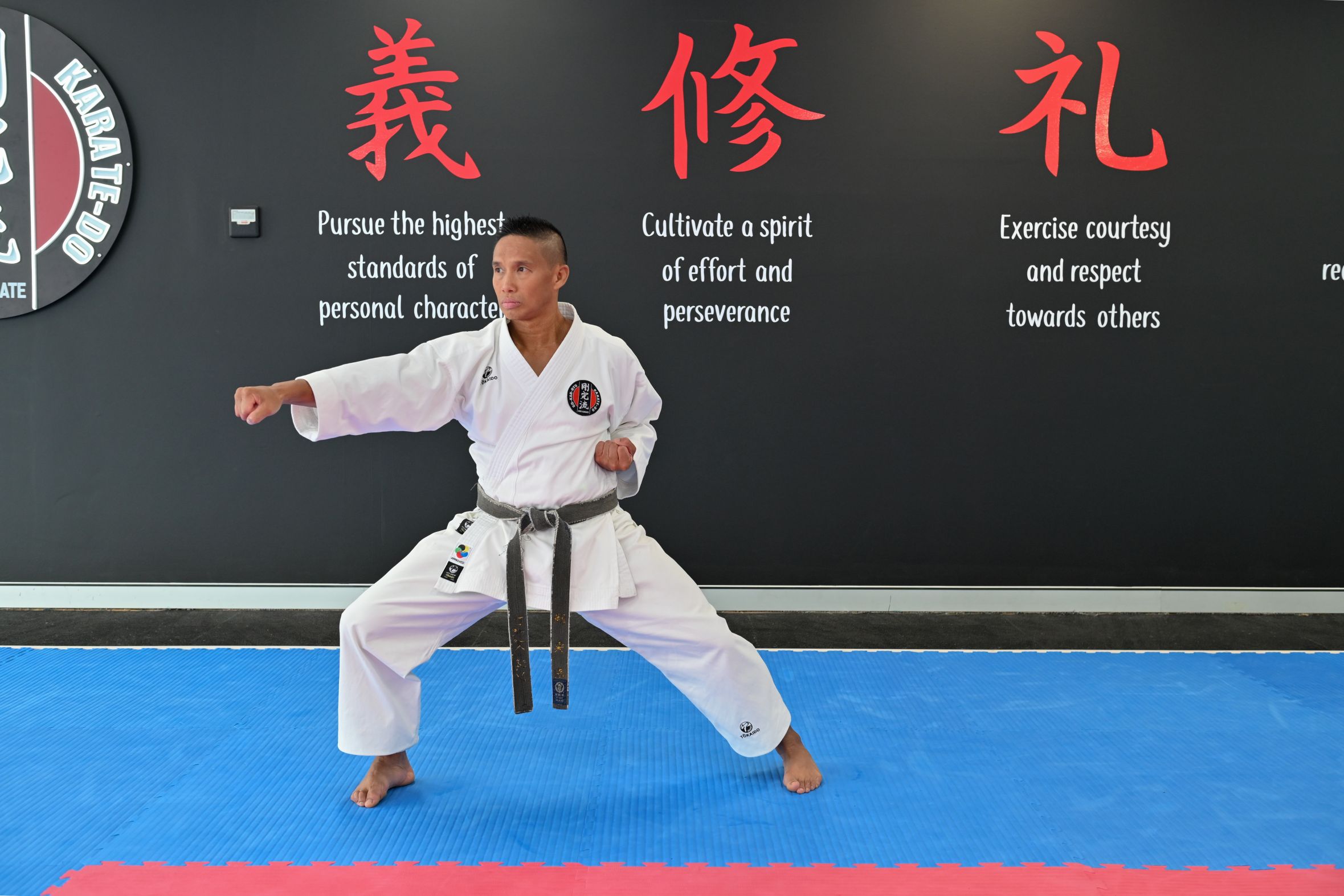
  • Counts 24 and 26:  Oi Tsuki Hanmi (Lunge punch with hips at 45-degrees)


    • Sochin is the only kta where a Chudan tsuki is performed in Fudo dachi.
    • It is important however, not to think of this like a Zekutsu dachi chudan tsuki (with hips 45-degrees). The Fudo dachi changes the entire dynamic of the punch.
    • A Zenkutsu dachi chudan tsuki with the hips on a 45-degree angle operates with Kime. The concept of snap still occurs. When we move do Fudo dachi, the concept moves from Kime to Chinkuchi (which is more of a pushing drive).
    • The bend back leg is what drives the front hip forward, like a pushing punch. Think of the punch trying to push through the opponent’s solar plexus. Similar to the way a boxer may throw a body jab.     
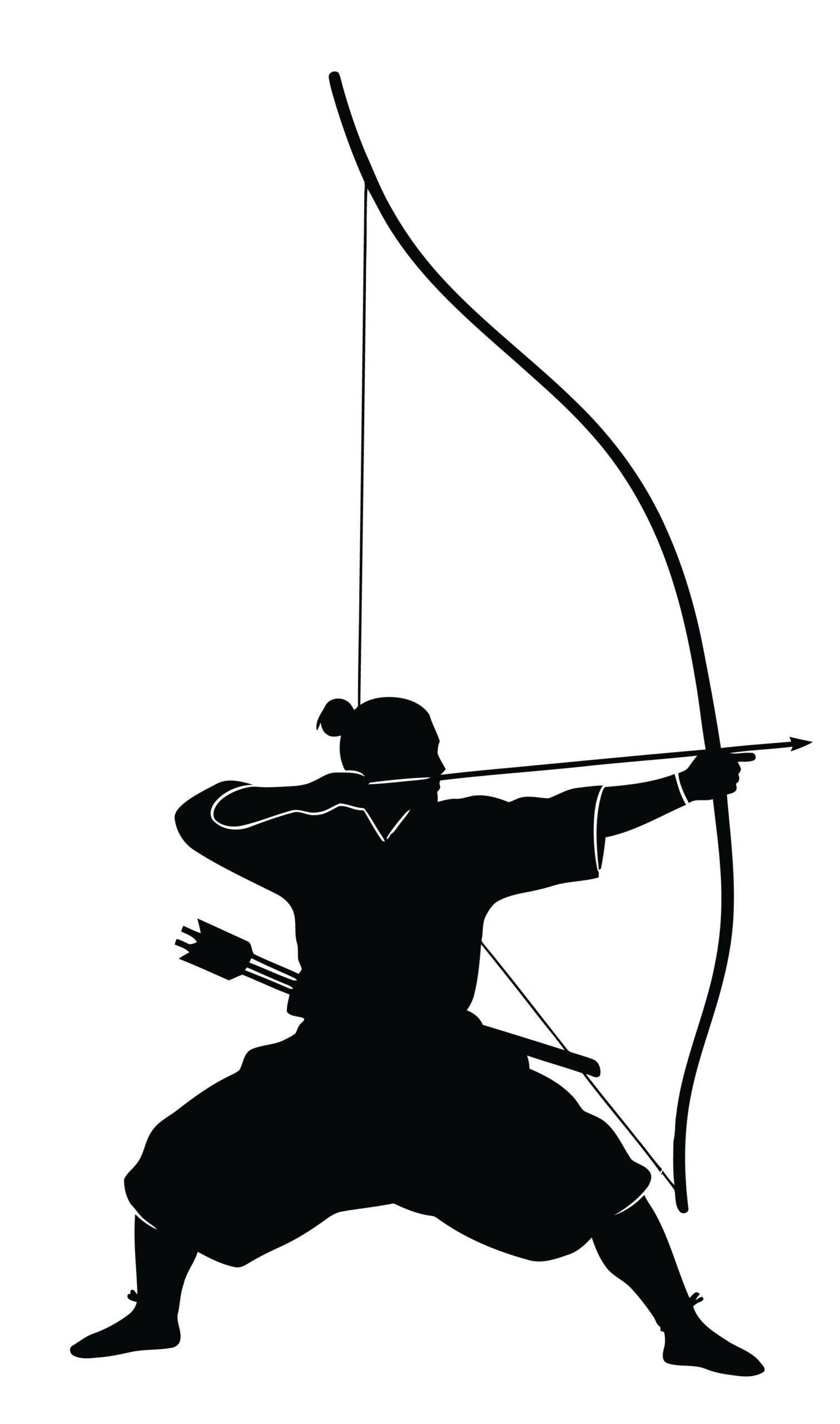
  • Count 28:  Kyudo Kai (Archer’s draw)

    • Count 28 commences with a Migi mae geri (right leg front kick). The kick then retracts back to Fudo dachi. It is important that the body doesn’t come back with the kick. The body should maintain its centre with the hips remaining square until the back foot just touches the ground.
    • The moment the right foot touches the ground, the back leg should push the hips forward to a Hanmi (45-degree) position. Effectively, the twisting of the hips should be used to create more power in the push-pull mechanism that comes after.
    • As the hips rotate on their longitudinal axis, the left arm pushes forward with a slow punch (although in application this is not seen as a punch). The right hand pulls back to a high hikite position where the palm faces down, and the rear hand is at the same height as the front hand.  
    • This posture resembles a Japanese Archer (Kyudo) in full draw (Kai). While this technique is not a bunkai for Kyu-jistsu (the art of archery, or the way it is used in battle), it can be seen as Kyu-do (which is the way of the bow). Kyudo focuses on meditation, spiritual training, and personal development, where the process of shooting is considered as important as or more important than hitting the target. Sochin’s second last move, performed with slow tension is like the Kyudo kai (kai is the full draw of the bow) where one applies themselves fully – mentally, physically and spiritually to the task – before firing on the final count.  

History Of Sochin

Despite modern karate regarding Seisan as a Goju Kata and Sochin as a Shotokan kata, what is interesting to note is that tracing back their lineage, one discovers they both came from the same Okinawan source, and both kata date back further than most other karate kata. While most Naha-te based kata were introduced or developed by Chogun Miyagi (founder of Goju) or Kanryo Higaonna (founder of Naha-te and Miyagi’s instructor), Sochin was introduced further back by Higaonna’s instructor, Seisho Aragaki. Seisan was also taught by Aragaki but it is unlikely that he introduced it.

It is these two very old kata (Seisan and Sochin) that highlights how the much-debated topic of, ‘which modern style of karate studies the truest version of katas’, is a waste of time. No single style, regardless of its roots can claim that they teach the truest or purest version of any kata because every kata has been altered and modified over the generations.

So how is it that two kata of the same source could end up at different ends of the traditional karate spectrum?

Assuming you have already read up on Seisan kata, you are aware that its originator is unknown and that it was practised by several Okinawan karate forefathers. The most famous is the Goju based version, which is the version practiced in Go-Kan-Ryu. It is worthy of noting however, that even within Goju, after the death of Miyagi, a number of versions have arisen from his top students, and while similar, each has stamped their own individual interpretation of the kata.

When it comes to Sochin kata, while Aragaki taught Higaonna (founder of Naha-te), he moved away from Naha to teach his brand of karate to martial artists in the city of Shuri (the term ‘brand’ is used because Aragaki never formalized a style).

While he taught many kata and also a number of weapons kata, two kata he founded and taught that became widely popular in Shuri city were ‘Unsu’ and ‘Sochin’. Later when Aragaki returned to Naha, Goju had been formed and was the most popular style. For this reason, Sochin was not so popular in Naha.

Despite its Naha (Goju) origin, most styles that practise Sochin today come from a Shuri (Shotokan) lineage. This has most likely resulted in the stances growing deeper (note Goju styles use mostly ‘neko-ashi datchi’ cat stance) and the tempo hastened. That said, its Naha roots are still very apparent in the opening sequences where the same pattern of movements are performed three times, like many Naha or Goju kata eg. Saifa, Seiunchin, Sanseryu, Shisochin, Seisan etc, and the blocking in these sequences is done slowly and with strength.

Furthermore – in the opening sequences – the hips when performing the slower movements should push forward, much the way they push forward when performing opening sequences of Goju kata in Sanchin dachi.

One person who truly appreciated Sochin was Kenwa Mabuni (1889 – 1952), a master who later formulated the popular style of Shito-Ryu. Note that Shito-Ryu (like Go-Kan-Ryu) utilises many kata from both Naha origin and Shuri/tomari origin. Mabuni likely changed Sochin somewhat when formalising Shito-Ryu as most Shito-Ryu kata are quite different to the same kata practised in their native styles.

As with all kata, over time, variations were introduced. The version that is most popular throughout the world today and the version practiced by Go-Kan-Ryu, is the Shotokan version, which was developed by Yoshitaka Funakoshi, son of master Gichin Funakoshi, the founder of Shotokan. Funakoshi’s son trained under Mabuni, where he learned Sochin and introduced it into Shotokan after he lengthened the stances and introduced the high side-kicks.

Because Sochin has a number of different styles that practise it and as such, a number of different versions, it also has different translations. Common names are ‘Grand prize’, ‘Grand battle, ‘Strong calm’ and ‘Immovable’ kata (a name representing the fudo-datchi stance used throughout). The most common translation is ‘Strong Calm’ which is also a very Naha styled name. This name is indicative in the kata’s form given its use of ‘strong’ fudo- dachi stances combining with slow, calm blocks (tate shuto uke).

The Following Is The Most Likely Sochin Lineage To GKR

Seisho Aragaki (1840 – 1918)

Developed by Seisho Aragaki based on his experience in Okinawa-te (the indigenous art of Okinawa) and his training in White Crane Kung Fu. Arakaki was born in 1840 in either Kumemura village (a Chinese settlement on the island of Okinawa found near Naha), or on the nearby island of Sesoku. He was an official in the Royal Court of Okinawa and as such held the title of Chikudon Peichin (which denoted a status similar to that of the Japanese Samurai). On 24 March 1867, he demonstrated Okinawan martial arts in Shuri city, then the capital of the Okinawa, to a visiting Chinese ambassador; this was a notable event, since experts such as other notable martial artists were still active at that time. Aragaki served as a Chinese language interpreter and travelled to China in September 1870. His only recorded martial arts instructor from this period was Wai Xinxian who taught white crane kung fu in the Fujian province.

Kenwa Mabuni (1889 – 1952)

Born in Shuri city Okinawa in 1889, he began his instruction at the age of 13, under the tutelage of the legendary Yasutsune Anko Itosu, who also taught Gichin Funakoshi. Mabuni was close friends with Chojun Miyagi who would later create the style of Goju. Miyagi introduced Mabuni to his instructor Kanryo Higaonna, the founder of Naha-te, and he began training in Naha-te. Later, Mabuni would found the style of Shito-ryu by taking the aspects of Shuri-te and Naha-te and suiting them to his style and body structure. Mabuni also trained under Higaonna’s instructor, Seisho Aragaki, where he likely learnt Sochin.

Yoshitaka Funakoshi (1906 – 1945)

Yoshitaka is the son of the famous Gichin Funakoshi. He learned Sochin from Kenwa Mabuni and introduced it into Shotokan. Like most people who integrated a kata from another system, he modified it to suit the Shotokan system’s techniques and ideologies.

GKR Karate

While many styles incorporate Sochin, GKR derives its from Shotokan karate.

GKR Karate Belt Journey
GKR Karate Belt Journey – Introduction How to Tie Your Karate Belt GKR Karate Grading Criteria You May Feel Like You’re Not Improving Break Through the Boredom Barrier Does Empty Hand Mean No Weapons? Kata Is A Tree With Many Branches Beware Of The Autopilot Enjoy Your Journey
White Belt 10th Kyu
Introduction Benefits of Karate Japanese Traditions Introduction to Stances Introduction to Strikes Introduction to Blocks Introduction to Kicks The Karate Grading System White Belt Kids Frequently Asked Questions
Yellow Belt 8th Kyu
Yellow Belt 8th Kyu – Introduction An Introduction to Kumite Relationship Between Kihon and Kumite Relationship Between Kata Kumite and Self Defence Grading Requirements for 7th Kyu Orange Belt
Orange Belt 7th Kyu
Orange Belt 7th Kyu – Introduction Introduction to Advanced Stances Introduction to Kata Gaining A Deeper Understanding of Kata First and Second Kata First Kata Technical Checklists Second Kata Technical Checklists Kata Home Practice Orange Belt 7th Kyu – Kumite Tips Grading Requirements for 6th Kyu Green Belt
Green Belt 6th Kyu
Green Belt 6th Kyu – Introduction Introduction to Kata Saifa What is Expected of You Applying What You Know The Magic Is In The First Few Punches Class Wants and Needs Green Belt 6th Kyu – Kumite Tips Grading Requirements For 5th Kyu Blue Belt
Blue Belt 5th Kyu
Blue Belt 5th Kyu – Introduction Introduction to Kata Bassai Dai Bassai Dai Technical Aspects and Self Defence Blue Belt Blues Blue Belt 5th Kyu – Kumite Tips Grading Requirements for 4th Kyu Red Belt
Red Belt 4th Kyu
Red Belt 4th Kyu – Introduction Greater Understanding of Bassai Dai The Journey Continues The Purpose of Kata Practice Beware of Your Autopilot Red Belt Potholes Grading Requirements for 3rd Kyu Brown Belt
Brown Belt 3rd Kyu
Brown Belt 3rd Kyu – Introduction Introduction to Kata Seiunchin Seiunchin Home Practice Remove Self Imposed Limitations Advanced Techniques Brown Belt 3rd Kyu – Kumite Tips Grading Requirements For 2nd Kyu Brown Belt
Brown Belt 2nd Kyu
Brown Belt 2nd Kyu – Introduction Introduction to Kata Empi Empi Home Practice Maintain Progress Brown Belt 2nd Kyu – Kumite Tips Grading Requirements for 1st Kyu Brown Belt
Brown Belt 1st Kyu
Brown Belt 1st Kyu – Introduction Introduction to Kata Sanseru Introduction to Kata Sepai Get On Track For Black Belt Brown Belt 1st Kyu – Kumite Tips Grading Requirements For Shodan Ho
Black Belt Shodan Ho
A New Journey Begins Introduction to Kata Hangetsu Hangetsu: Home Practice Advanced Techniques Shodan Ho Kumite Tips Grading Requirements for Shodan 1st Dan Black Belt
Black Belt 1st Dan
Introduction to Kanku Dai Introduction to Kururunfa Focus On The Journey Not The Destination Going From Good to Great A Black Belt Is Always A Black Belt Shodan Kumite Tips Grading Requirements For Nidan 2nd Dan Black Belt
Black Belt 2nd Dan
Become A Knowledge Seeker Introduction to Shisochin Introduction to Kanku Sho Tips For Kata Progress Nidan Kumite Tips Grading Requirements For Sandan 3rd Dan Black Belt
Black Belt 3rd Dan
Introduction to Kata Seisan Introduction to Kata Sochin Sandan Kumite Tips
Black Belt 4th Dan & Above
Introduction to Kata Shokan-Te Introduction to Kata Nikan-Te Introduction to Kata Sankan-Te

Membership Enquiry

GKR Karate brings the exciting Martial Art of Karate to everyone. We are passionate about sharing our skills and knowledge, and we aim to inspire and empower people to reach their maximum potential through the consistent practice of Karate. We are a family club that is dedicated to fostering sound values and developing strong, humble, brave individuals and healthy communities.

If you’re interested in finding out more about joining GKR Karate, submit your details below and we will be in touch!

First Name
Last Name
Email
Phone
City
State/City/County
Country
Message
Please verify you are a human being.
GKR Karate
© GKR Karate 2026 • Website by The Digital Embassy
  • About GKR Karate
  • •
  • Articles
  • •
  • Club Partners
  • •
  • Contact Us
  • •
  • Privacy Policy
  • •
  • Terms and Conditions
  • •
  • Cookie Settings
GKR Karate
  • About GKR Karate
  • Articles
  • Club Partners
  • Contact Us
  • Privacy Policy
  • Terms and Conditions
  • Cookie Settings
© GKR Karate 2026 • Website by The Digital Embassy
This website may capture information to improve user experience. By using our website you consent to this in accordance with our Privacy Statement. Privacy Policy
Read More

Select Your Country

AU

NZ

UK

This website uses cookies to improve your experience. Privacy Policy

Decline Cookie Settings
Accept All
Powered by WPLP Compliance Platform
Cookies are small text files that can be used by websites to make a user's experience more efficient. The law states that we can store cookies on your device if they are strictly necessary for the operation of this site. For all other types of cookies we need your permission. This site uses different types of cookies. Some cookies are placed by third party services that appear on our pages.
  • Necessary
    Always Active
    Necessary cookies help make a website usable by enabling basic functions like page navigation and access to secure areas of the website. The website cannot function properly without these cookies.

  • Marketing
    Marketing cookies are used to track visitors across websites. The intention is to display ads that are relevant and engaging for the individual user and thereby more valuable for publishers and third party advertisers.

  • Analytics
    Analytics cookies help website owners to understand how visitors interact with websites by collecting and reporting information anonymously.

  • Preferences
    Preference cookies enable a website to remember information that changes the way the website behaves or looks, like your preferred language or the region that you are in.

  • Unclassified
    Unclassified cookies are cookies that we are in the process of classifying, together with the providers of individual cookies.

Powered by WPLP Compliance Platform
Cookie Settings